There are lots of reasons to be worried or excited about the upcoming US midterms, but as a transit advocate, I’m most worried about the San Francisco Bay Area’s Measure RTM, which would raise the sales tax by half a cent (a full cent in San Francisco) for 14 years to prevent catastrophic cuts to the Bay Area’s busiest transit services.
This measure will have consequences nationwide. Its failure, which polls suggest is possible, would intimidate any other US metro area that is thinking of seeking transit funding at the ballot box. All over the country, people will say, “if the most liberal metro area in the country won’t vote for transit, what hope do we have?” So the likely outcome of RTM’s failure is more of what we’re seeing now across the US: Massive, ruinous cuts in transit service, done in many cities without even asking the voters if this is what they want.
Contents
- Why Transit is in Trouble Across the US
- How Bad Would the Cuts Be?
- But Would These Cuts Really Happen?
- But there’s all this other money!
- Is the NO Campaign Being Straight With Us?
- Coda: Aren’t You Consultants Just Feathering Your Nests?
Why Transit is in Trouble Across the US
US public transit agencies are in financial trouble almost everywhere, and for the same reasons:
- Large urban agencies were very dependent on fare revenue before Covid, especially from rush hour commuters. Covid and working from home have eliminated much of this revenue source. Competent agencies have redesigned their service to match the all-day, all-direction markets that people still value, but it is unreasonable to expect a return to 2019 ridership and revenue anytime soon.
- Running a bus or train has become more expensive, mostly because of the rising cost of labor. It’s fun to blame unions for this, but the real culprit is the free market for labor. The explosion of delivery services has created a huge supply of jobs for people who like driving, so transit agencies are having to pay more for these skills. Ask your transit agency if they have had trouble hiring and retaining drivers and mechanics. If they have, that means wages aren’t too high for the market.
- Security has become an all-consuming concern since Covid. This issue is both a real concern and cynically amplified in the right-wing media. Many urban agencies have dramatically increased what they spend on security. Now, although crime on transit is way down (BART crime went down 41% from 2024 to 2025), few agencies feel they can dial back this spending.
- Some agencies have other issues. For example, a great deal of rail transit was built in the 1970s through 1990s, and much of this infrastructure needs refurbishment.
How Bad Would the Cuts Be?
Very, very bad.
- BART, the transit backbone of the central Bay Area, would cut frequencies to every 30 minutes even on some of its busiest segments, such as the one through Berkeley, as well as on almost all of its suburban network. This drop will cause a dramatic ridership loss, because BART will cease to be a service that is coming whenever you need it, and instead become a service that you must plan your life around. All over the industry, ridership data shows us that 30-minute service is much more than twice as bad as 15-minute service, although it costs only half as much.
- Next summer, BART would shut down its lowest ridership segments, probably including the Dublin, Antioch, and Oakland Airport links, and close lower-ridership stations throughout the system.

The details of these service cuts have not been adopted by the BART Board, but this is the amount of service cut that would be needed if RTM fails. If they don’t close these stations, they will probably have to close others.
- Caltrain would fall back from 30-minute frequency to 60, end service at 9 pm, cut weekend service, and close 10 of its 31 stations. This line serves a long string of walkable downtowns between San Francisco and San Jose, and should be running every 15 minutes. Running every hour, it will be the service that people remember from before it was electrified: Fast when it comes, but probably not coming when you need it. Elimination of weekend service will drive away anyone who commutes on both weekdays and weekend days, a significant share of the transit-amenable population.
- Bus networks throughout the five affected counties would also have to make major cuts in both frequency and coverage.
Will this increase traffic? Definitely, but it will do much worse things:
- It will undermine efforts to develop denser housing around major transit stations, to address the housing affordability crisis.
- It will devastate the lives of many people living without cars. Some of them will buy cars, while many others will just lose jobs, educational opportunities, and so on.
But Would These Cuts Really Happen?
Sometimes, transit agencies promise they will have to cut if a measure fails, and then the measure fails and they don’t.
This happens because the actual failure of the measure causes a sudden increase in focus on the part of elected officials. The Bay Area has a few inspired leaders who care deeply about transit, but there are also a lot of passive or uninterested leaders, and it’s not unusual for those to be roused only when things are truly on the edge of disaster and everyone is calling them demanding solutions. This relentless apathy of the powerful, which has been worse since Covid, is one of the main reasons that US transit so often seems to be in crisis. Transit has crises because only a crisis makes apathetic leaders care.
In the Bay Area’s case, however, there just may not be time to enact another solution, because BART reports being very close to the cliff. Their catastrophic service cuts are scheduled for January and July of 2027. Could some politicians come up with a one-time fix that will push that back a year to give them time to work? It has happened. Even so, things would remain in a state of emergency, with constant news stories about imminent apocalypse, through the 2028 election, which is likely the next time a funding package could be presented to the voters. Is that what we want?
But there’s all this other money!
No, there are other pots of money tied to infrastructure projects, but reallocating that money to plug holes in the operating budget is both legally hard and requires politicians to act against the interest of their own constituents. Also, these infrastructure projects have lots of supporters!
The three biggest pots of money that the measure opponents like to point to are these:
- The BART extension through downtown San Jose. It’s crucial to remember that VTA, the Santa Clara County transit agency, is paying for this project with its own sales tax money (about $4.6 billion of the $12.7 billion cost), plus state grants and a roughly $5.1 billion federal grant. Why should their politicians agree to send any of their money north to the central Bay Area, where the most immediate crisis is? Even if the BART extension were cancelled, Santa Clara County politicians would want to keep their money at home.
- The California High Speed Rail Project. The NO campaign wants to redirect the roughly $1 billion a year of state cap-and-invest money now committed to it. This is money collected from all over the state! Why should legislators from the rest of the state, whose own transit agencies also want that money, agree to send it to the Bay Area? And while there are Central Valley Republicans who want to kill the whole thing, they have no motive to help out the Bay Area. A statewide consensus to shift a lot of money out of this project to save Bay Area transit seems fanciful on the surface and certainly would not happen quickly.
- The downtown San Francisco extension of Caltrain, also needed for the eventual high-speed rail that RTM opponents want to kill. The entire Peninsula is the big loser if this project dies. Why should its politicians support shifting the resources to BART, which only serves a small fragment of this long, busy corridor?
Finally, the NO campaign loves to talk about salaries of transit executives and about overtime pay for frontline staff. A lot of overtime is happening mostly because hiring is difficult, and the difficulties of hiring are proof enough that despite the powerful unions, frontline transit staff are not massively overpaid. Executive compensation is sometimes higher than I might like (and far more than I’ve ever earned as a consultant!) but these are very hard jobs and we need highly skilled people to do them. In any case, these are minuscule numbers compared to the volumes of money needed to maintain the transit system for a major urban region.
Is the NO Campaign Being Straight With Us?
No, they are contradicting themselves on the most basic question of their intentions. They claim that other money will come to the rescue to prevent the cuts that the transit agencies promise if RTM fails. They want people to vote no believing that this will make transit more efficient. But at the same time they say things like this on their website:
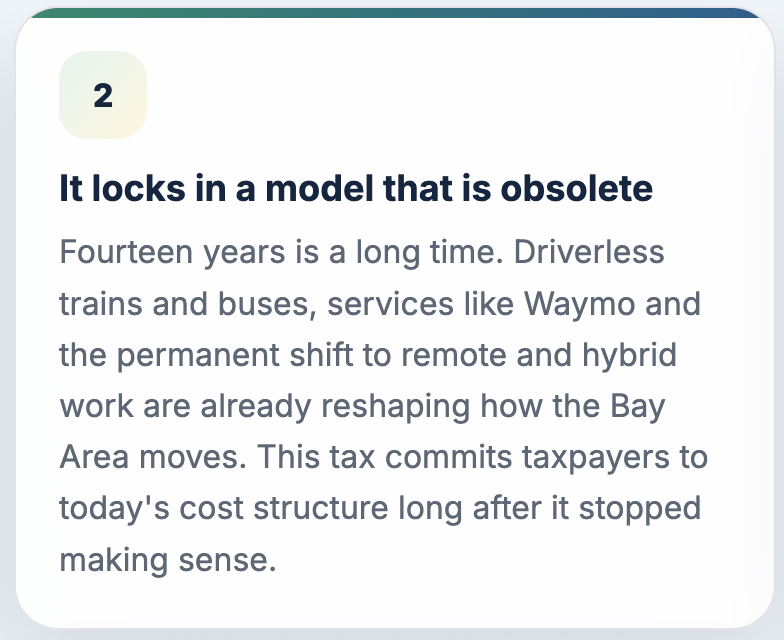
This is the most important signal of all: While assuring transit advocates that they are on our side, the No on RTM campaign is signaling to anti-transit zealots in the tech industry that they are aiming to destroy public transit so that emerging technologies have less competition.
This paragraph throws so much stuff at the wall at once that I need to take it apart:
- “Driverless trains and buses.” Driverless trains have been transporting passengers for more than 40 years in Vancouver, Canada, and yes, the technology could conceivably apply to the grade-separated BART system, though not without a lot of expense. Driverless operation of at-grade systems such as Caltrain, and of buses, is further away. As long as safety and security remain a concern, removing the last paid employee on a transit vehicle seems like a difficult proposition from the standpoint of customer acceptance.
- “Remote and hybrid work.” Elite projection alert! Many, many people have jobs that can’t be done remotely. They tend to have lower incomes and be more open to transit use, but they are not “dependent”; they will buy cars and add to congestion if we force them to. Also, transit is no longer just about the journey to work. All kinds of other trip purposes contribute to transit ridership.
- “Waymo.” Here’s the real winner of the “No on RTM” campaign. Like all businesses, Waymo would benefit from less competition. Waymo as we know it cannot scale to serve either (a) local travel within the region’s dense core or (b) long trips across the region where freeway space is limited. A triumph of driverless cars over public transit would be a traffic apocalypse. Voters need to decide if they really want to have so few choices.
As usual with transit funding measures, the NO campaign has the easier job. Being against taxes is easy. Even in the Bay Area, that gives you 35% of the vote before you even start campaigning. The YES campaign, on the other hand, must explain and justify the need. The NO campaign can just throw all kinds of accusations at the measure, with no obligation to be consistent. Only the YES campaign is judged on consistency. A NO campaign can profit from confusion, while a YES campaign profits only from understanding.
That’s why my advice from my more general piece on tax measures applies here. “If you’re still confused, remember: All the confused people are voting NO, so vote YES.”
Coda: Aren’t You Consultants Just Feathering Your Nests?
People who understand transit well tend to have jobs related to it. So the NO campaign can attack all these people as self-interested. Surely, the transit experts are all supporting transit because there’s money in it for them!
Notice the echo of MAGA here. Telling people to be suspicious of all experts is a key step in making them vulnerable to scams.
The funders of the YES campaign certainly include companies that will profit from it, notably big consulting and engineering firms who would lose work if major projects are cancelled. But almost every proposal, no matter how virtuous, has self-interested people supporting it. This is normal and boring and should not affect your vote. After all, the NO campaign is also based on self-interest: some people want lower taxes and think they won’t be the ones who suffer from transit’s collapse.
As I’ve commented on this measure on social media, I have personally received lots of social media attacks suspecting me of being interested only in profit. So let me end by reminding the good people of the NO campaign of some inconvenient facts.
- Not all consultants are greedy monsters. We, for example, are a 20-person firm that is owned entirely by its senior employees. Compared to the money needed for transit operations and infrastructure, our compensation is a rounding error. We mostly help agencies think about service planning, and right now, several agencies across the US have hired us to help them plan devastating service cuts while doing as little damage as possible. So if RTM fails, we will be fine. We have no financial interest either way.
- Some people believe in their work. All the professionals at our firm are talented enough to be doing something much more profitable. They do what they’re doing because they really believe in transit and have a passionate commitment to it that is worth making some sacrifices for. Transit agency staffs also include many people like that. The NO campaign’s accusations suggest a complete inability to imagine that such people exist, and that there are goals in life other than greed. Well, I’m sorry, but there are.
So the NO campaign’s effort to brand us all as greedy elites is nonsensical. The real reason for these slanders is that many of us are good explainers, and a clear explanation of the Bay Area transit crisis is the last thing the NO campaign wants you to hear.
The bus part of this is what would hit my Saturdays first, before any rail cut. Right now the 48 westbound still runs about every 20 minutes through midday, with scheduled departures from 17th Ave and Quintara toward Great Highway at 11:40 AM, 12:00 PM and 12:20 PM, so a missed bus is a short wait, not a ruined afternoon. That’s the kind of ordinary frequency that disappears quietly when a network has to cut coverage and frequency together. The Saturday timetable for that branch is here: https://train-bus-schedule.org/us/ca/san-francisco/muni/48/schedule/?pattern=17e9447b521862599a735192&stop=7572
I find it ironic that the right has been so successful in their elites branding…considering their president boasted to his crowd at one of his rallies that they wouldn’t be able to afford to eat much at his exclusive club even if they were to get his mythical $5000 check…
and isn’t it ironic that the so-called anti-elite campaign is relying on elite projection for its arguments?
This a bit of theorizing on the inner workings of the Opposition. Marc Joffe is basically the Peter Mcculloch or Sabine Hossenfeld of a new generation of libertarian Psudo Urbanists. Unlike the days of Randal O Toole, most of the general public has a better view on transit than they did about 10-15 years ago. This is a a problem for American libertarians as they are geographic determinists who thinks transit only works in the northeast or a handful of pre determined places and work on their terms such as gutting pay and other delusions of “efficiency”. Joffe appears to be a “transit rider” and uses his position as a rider to guide his beliefs to create said “Efficiency” in the vain of DOGE and Milleism. Finally Joffe is using “It locks in a model that is obsolete“ as a dog whistle for his libertarian base to unify his coalition to take over what O Toole started. Since 2018 the anti transit right has struggled to find footing in a generation wanting to break free from car dependency. I also think that this will not benefit Waymo, Zoox and other driverless companies in the long run. As driverless auto makers trying to act independent of transportation ecosystem, it effectively alienates riders and wider public as little more than cartoonish villains seeking to preserve a obsolete way of living by biting more than they can chew which won’t help them when the Ai bubble bursts and money is scare.
I really think that Mark Joffe is trying to be the moderate successor of Randal O Toole. His coalition consists of various contradictory factions, such as the anti-high-speed rail right and the transit skeptical moderates. Both have interests that would balk at fully implementing any part of the coalition’s vision. I also don’t think Waymo would benefit, as they would likely get a “Roger Rabbit treatment” in the eyes of younger generations.
Do you care enough to address the extremely obvious criticism that last time we voted to fund transit, they used the money to completely break the Clipper fare system and BART fare gates?
I’m mad about that too but I question how cutting BART service will fix that. If you think the management is bad, elect new Board members.
We do not elect the MTC board directors who are responsible for the Clipper fare control system.
RTM is not a perfect measure but is still important. My partner was skeptical about voting for it because our San Francisco sales tax goes up 1% (to 9.7% or so, round up to 10%). At least (I think) most of our SF tax goes towards MUNI operations… most of the other Bay counties get a half-point tax increase and can spend half that income on paving streets. I made my best case that it’s worth voting for (as I am likely to do).
I don’t know if this will be approved, let alone before the polls close, but I want to echo Eric McWray’s perspective.
While I’m adamant that BART, Caltrain, and AC Transit planned reckless and arbitrary cuts instead of targeting their contingency plans, there’s nothing to cut at San Francisco Muni.
The 48 bus that Eric mentions is a transversal line, and like so many other secondary bus lines, it now runs every 20 minutes, a historic low. You won’t have a workable grid system left if you go below 20 minutes. If you cut the remaining secondary bus lines, crowding on trunk lines like the 38 Geary, already unpleasant, becomes impossible.
As I mentioned in a comment on the stub pointing to the general piece on transit taxes, California Proposition 43 could mean no second chance if RTM fails. 43 requires two thirds supermajority approval of all special taxes, not just some.
That’s impossible when you mix urban and suburban counties. The original BARTD property tax (just 3 counties, not 5 like Measure RTM) got 61%. It passed because back then, the state legislature still had the authority to reduce the supermajority threshold. (They reduced it to 60%.) 43 eliminates the 50% threshold for special taxes placed on the ballot through signature-gathering.
I’ll reprise my comment about the indiscriminate BART, Caltrain, and AC Transit contingency plans because passing Measure RTM is only the start of the political work of fixing Bay Area transit. Rising unit costs guarantee service cuts in a few years even with RTM, unless something changes. (The accountability/efficiency provisions in RTM are meaningless, for a reason I’ll explain after the election. It’s funny that not even the opposition group noticed the real loophole.)
The San Francisco Bay Area is an extreme case with 20+ separate transit agencies. When resources get scarce, cooperation preserves mobility, but that requires more effort from transit leaders, managers, and planners (and less ego). Duplication is easier than cooperation.
Now, with Measure RTM at risk, the separate boards of BART, Caltrain, and AC Transit have approved, and the Metropolitan Transportation Commission has tacitly accepted, zero-cooperation contingency plans!
BART
BART funded and managed a high-quality express bus network before rail extensions began to open in the mid-1990s. BART’s plan in case Measure RTM fails does not mention the word “bus” at all! During the first phase, the agency will starve its busy core network to run half-hourly service even to the deep suburbs.
Weekday BART ridership is less than before the extensions opened, less than half the historic peak in 2016, and half what it was before the pandemic. (Weekend ridership is recovering faster, but it’s far less than weekday ridership. Commuters still count, and you can see with your own two eyes that the Bay Bridge still slows to a crawl at rush hour.)
No BART extension has ever come anywhere near meeting the ridership projections on which its environmental impact report was based. Closing extensions outside commute hours and reviving the BART Express Bus is entirely reasonable.
The old service was coordinated: same days and hours, premium bus subfleet, bus and train schedules in the same brochure, one customer service center to answer questions about both modes, and dispatch-level communication to hold buses for late trains. (You might still spot rotating orange beacons at some BART stations.)
Caltrain
samTrans funded and managed high-quality express bus service (Route 7F/KX) between San Mateo County, SFO, and San Francisco before the BART SFO extension and the Millbrae BART/Caltrain station opened. For most of its history, Caltrain was part of samTrans. The contingency service framework for Caltrain axes all night and weekend Caltrain service but makes no mention of the word “bus”.
AC Transit
AC Transit’s contingency plan prioritizes mode over mobility. The agency will cut its local bus network more deeply than necessary, for the sake of preserving full 10-minute service on its most expensive route, the 1T Tempo bus rapid transit line.
Tempo runs entirely in the shadow of BART, covering 6 BART stations. Tempo isn’t busy because people like it. Tempo is busy because AC Transit local bus riders are poor. BART does not accept AC Transit day, weekly, or 31-day passes, even for trips wholly within this 6-station corridor, and even though AC Transit accumulator passes are stored on the same Clipper Card that BART relies on.
BART debits its own fare for every ride, every time, the only exception being for trips between 8 San Francisco stations, for people who pay extra for the premium variant of the San Francisco Muni Fast Pass (now stored on Clipper, too).
Equity note: Very poor riders ride Tempo for free by boarding from the rear doors or flashing an animated GIF image that fakes the TokenTransit app. It’s now difficult for them to ride BART for free. They either have to “tailgate”, passing closely behind other riders as they go through the new fare gates, or ask station agents to open the manual swing gate. The poorest riders cannot use Clipper Start, the MTC’s middle-class, bureaucratic response. It only provides a 50% discount, you need documentation and a fixed address to get it, and to load money, you need a smart phone with data service, plus a credit or debit card. For cash, there are very few Clipper Card machines or reload vendors in poor neighborhoods. The fact that very poor riders have to access transit by not paying is ignored; all fare equity analyses presuppose fare payment.
Historic note: The MTC has spent over half a billion dollars on Clipper, one card that can be used to store and pay separate fares under 20+ fare ordinances passed by 20+ transit boards. The BART Plus Ticket, an add-on that worked as a flash pass on all the local bus agencies, was discontinued. Transit agencies in the Bay Area cooperate LESS on fares than they used to! A transfer discount is not fare integration!
Whereas BART and Caltrain make no mention of bus service in their contingency documents, AC Transit mentions BART once, to apologize that some surviving neighborhood bus routes will run every 40 minutes, an absurd choice incompatible with BART’s planned 30-minute frequency, let alone with the clockface and human memory.
There’s no thought of negotiating a fare agreement so that BART can handle the Oakland-Fruitvale-San Leandro backbone and AC Transit, the “last mile”, and money wasted running Tempo buses every 10 minutes can instead be used to sustain a little more of AC Transit’s neighborhood bus network.
Let’s hope Measure RTM passes but keep working to fix Bay Area public transit.