In the US and Canada we are seeing ever more explicit messaging that advocates letting public transit wither into irrelevance. I’m growing more concerned about this angle in particular:
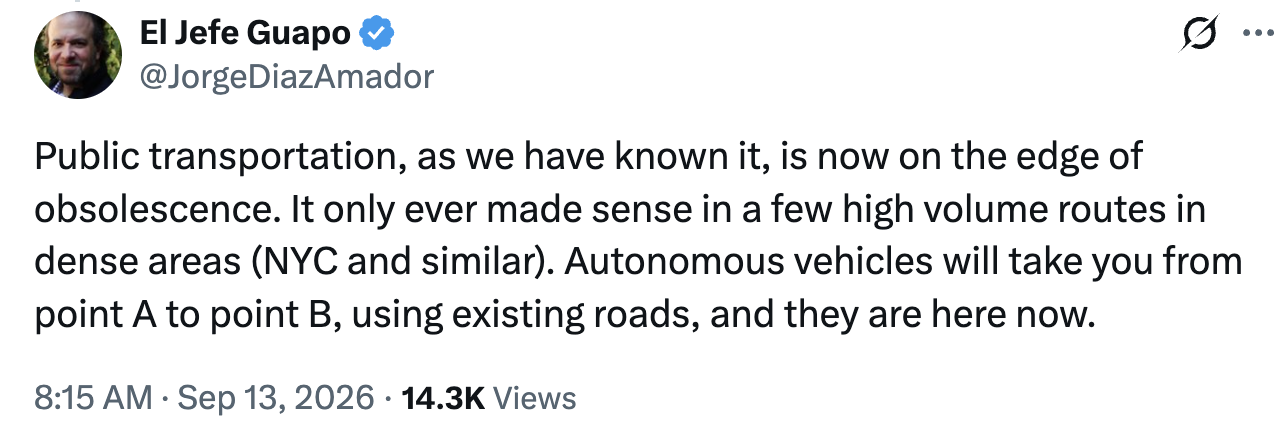
(The author of this post appears to work in optics for Tesla’s autonomous vehicle technology.)
If you recoil from this idea, let me assure you that it is very, very compelling to many people. In many transport-technology circles it’s taken for granted. It also resonates generally with the daily life of many people who live in the suburbs, see mostly empty buses go by, and have used autonomous taxis enough to see their potential. An argument that generally resonates with someone’s experience is going to be more powerful, no matter how wrong or misleading it is.
So I want to lay out, as respectfully as I can, all the ways this argument is wrong. I hope this is useful for you as you engage with this argument in your own conversations.
- The argument does not apply to dense cities, where the defining problem of transportation is how to share a limited amount of space. Autonomous cars use this space very inefficiently, just as all cars do. Every dense city will find that it has to limit the use of cars of all kinds because there is simply not room for them all if everyone uses them. This can take the form of (de)congestion pricing as well as the creation of more space for non-car modes to travel (bus lanes, bike lanes etc.) In dense cities, if everyone uses a car, nobody moves. It doesn’t matter that the vehicle is autonomous.
- It doesn’t even apply to longer journeys across large suburban regions, for the same reason. Dense cities will always be plugged with as much traffic as they make room for, because density means that many, many trips are arriving and departing on each block all the time. Across larger suburban regions, though, freeways that concentrate long-distance traffic also fail if they are the only means for going such distances. Many suburban areas with generally low density have manageable traffic on their streets but terrible traffic on their freeways and on the approaches to them. Autonomy is not a solution to this problem. The problem is cars and the lack of alternatives to them.
- Autonomous vehicles are “here now” only in certain cities. The problem of winter driving continues to be a challenge for them, although it is certainly being worked on. Small cities and rural areas, where otherwise isolated people could benefit most from autonomy, appear to be last in line because the companies promoting these services want the mass usage that only cities can offer.
- Autonomous vehicles are not “here” for persons with lower incomes, and it’s not clear they will be. In theory, the removal of drivers from taxi operations could dramatically reduce their cost and thus their fares. Elon Musk has made this claim explicitly. But Electrek’s analysis estimates Tesla’s hypothetical New York City robotaxi at around $0.66/mile versus NYC transit’s $0.34/mile — still much cheaper than Uber, but not actually competitive with transit fares. Waymo currently costs about the same as Uber and Lyft, if not a little more, so it is not an option for a very large share of the population, many of whom find transit a more cost-effective choice. Nobody really knows when or how fast the price will come down.
When the argument turns to this last point, affordability, a lot depends on exactly how financially comfortable people think about those who are less comfortable. It is very common, especially on social media, for people to pontificate in ways that suggest that people with low incomes are just not visible to them. These attitudes have several strands, and when you hear someone talking this way it’s important to delve and understand which kind of misunderstanding is at work:
- Elite projection is when fortunate people refer to their own personal experience as though it was a good guide to how everyone makes decisions. It is very common in the way that many fortunate people think and talk, especially in the US. Elite projection is mostly an innocent lack of awareness and needs to be confronted gently, without the assumption that the people who do it are bad people. I explored this crucial factor in detail here.
- Viewing transit as a charity for the unfortunate is a little better, because at least the low-income person is being seen. This tends to show up in the attitude that transit should exist because we vaguely care about those people, but that we should spend as little as possible on it and not care about the customer experience.
- Generalized conservative hostility toward low-income people, often accompanied by various stereotypes about them, is also common enough but I don’t worry about it. People who have such hardened attitudes are very far from being a majority, even if they often seem to dominate social media.
What all these views miss is the ways that a city that respects people with lower incomes works better for everyone, including the most fortunate.
- Lower-income people will generate traffic congestion if you force them to. Some of them aspire to own cars as soon as they can, but many buy cars because there is no viable alternative where they live. Car ownership rose in the late-2010s in many US cities, partly because especially favorable loans were being offered. Low-income people can also draw on informal networks, such as getting a ride from a friend or relative. Note that these “chauffeured” trips can generate even more congestion than the person driving alone. A common example: Mom takes their kid to school, making a round trip from home to school. They go back in the afternoon to pick them up, generating another round trip. That’s twice as much driving as if the kid had driven themselves. Good transit systems enable people to make other choices that reduce traffic congestion that affects everyone.
- Lower-income people’s ability to participate in the economy benefits everyone, not just themselves. Low-wage jobs need to be filled and they are often far from where a person making that wage can afford to live. Transportation problems are a top reason for not holding a job in the US. The resulting unemployment is a drag on the whole economy and on social services that all taxpayers pay for.
Seeing this requires seeing the diversity of people with low incomes, who make many different choices in the same situation. That’s why I push back against almost all generalizations about such people. The term “transit dependent”, for example, is very misleading. Low-income people themselves often describe themselves as “dependent” when defending a service they use, but it is equally important to stress that without the service, people will adjust their lives in other ways that will create other problems, and not just for them.
Arguments about transit often appear to be about technology but often mask an attitude toward less fortunate people, and the original post I quoted above is a good example. To say that autonomous taxis are “here now” is to say that they are here for the people who matter. So always ask: Who is being excluded by this seemingly appealing argument. It goes back to that ever-useful adage: In whatever room you are in, ask: ‘Who is not in the room?’
How do you see tolls, whether for (de)congestion in city areas or on freeways surrounding cities, playing a role in US and Canada transportation policy? If they are to play a role, how do you see policy builders framing them as beneficial?
Also, in the section “Car ownership roles in the late-2010s in many US cities,” did you mean rose?
I enjoyed the post, thank you!
Typo fixed, thanks.
Yes, all tolls discourage driving so regardless of their stated purpose, they count as decongestion pricing as long as there is an alternative mode such as a parallel transit line.
Thank you for the post! Waymo has grown into a highly approved method of transport in San Francisco, where I live, for its safety and comfort for riders and pedestrians. It is also true that many people have had the experience of seeing a Waymo cause congestion, or seen congestion cuased by cohorts of Waymos cruising for a client. A lot of the Waymos have now started driving more aggressively, and remained expensive. I do wonder how they will be able to develop further and maintain their approval as they inevitably cause more and more congestion.
1) This argument does apply to dense cities, if you understand that self-driving is not just for cars, it’s for vans too. https://www.youtube.com/watch?v=2M2CrXLAHo4
3) Indeed, it’s only here in some places, and the future is not evenly distributed. But statement you hope to refute was a prediction for the future. You can’t refute it by saying it’s not yet come to pass. At this point, you have to show why this technology won’t spread.
4) Again, don’t be fooled by the present. The unsubsidized cost of U.S. transit isn’t here for people of lower incomes either. I know you’ve seen the farebox recovery ratios. The cost of robotaxi rides is very likely going to drop well below those costs. If we want to provide equity for people with low income, then subsidize _their_ rides, not the rides of the wealthy, and let them pick what transport works best for them and afford it using that subsidy. Transit should not the charity. The charity should help the less fortunate, not pick the solution.
The answer to congestion is here, in advanced congestion charging and metering, which robotaxis will be the best actors for, because they obey what you program them to. To help the lower income, do it revenue neutral. Charge $20 to drive in the congested zone, but give everybody $5 credit each day. Suddenly people are very motivated to go 4 to a car, or 12 to a van. If you control demand, you don’t get induced demand.
Focus on our goals for transportation. Not the means. Robocars, cars, trains, buses, bikes are all means, not goals. Focus on fast, reliable pleasant trips with low externalities that all can afford.
“The cost of robotaxi rides is very likely going to drop well below those costs”
Based on what? Waymo isn’t even cost competitive with Uber/Lyft.
No robotaxi company has been operating on its own for any amount of time. There is no way to know what the long term prognosis for the mode without some understanding of its general profitability (or lack thereof). To say that they are “here” from a technical standpoint ignores the actual question at hand: are they here from a mass adoption standpoint? I see no evidence of that, and most robotaxi companies seem to operate more as propaganda for the parent companies than as the qualitative shift promises by proponents.
Great piece. How do you respond to the argument that “we’re not actually talking about AV taxis, we’re talking about AV shuttles and minibuses making public transit obsolete”?
I’ve tried to explain to AV promoters that timetabled, fixed-route service is the inevitable end state of any transportation involving more than a few riders but have not been incredibly successful.
Thanks for this. Finally, comprehensive counter-arguments against the AV Waymo et al insanity. Am posting this on our Friday Reads this week.
I always use your ‘geometry’ argument for silly rhetoric like this.
Sorry, I mean silly rhetoric from the self-driving car / micro-transit proponents of course, not from you who speaks sense
This is excellent – thank you.
After a decade and a half of Uber and Lyft, the last technology to render transit “obsolete” but did not, community support for mass transit did not waver and in some cases strengthened. When you look at local tax measures to support transit capital or operations, about 3 of 4 have passed in the ride-hail era.
I don’t see robovehicles as a technological inevitability, unless techbros and pitchdecks make an attempt on transit systems’ lives (like tax revolts or counting on Trump or GOP-run states to zero out funding or liquidate agencies). The 2020s is different, largely because Uber and Lyft are pillars of the disruptocene. There has been a cultural shift, among Democrats and Republicans for their own reasons, toward technology.
From the 1990s mass adoption to the 2000s with the arrival of smartphones, technology was enthusiastically embraced and viewed positively. After the disruptocene and the rise of social media, ride-hail and short term rentals, the enthusiasm started waning. In the 2020s, with the face of tech being crypto, smartphone gambling and AI, people are now openly hostile to tech. Both Democrats and Republicans have separate grievances, with some overlap, but the hostility is palpable.
Robocars are coming to market at the wrong time, and even if they manage to undercut human-driven ride-hail, the remnants of monopoly taxis, and yes, transit, they are going to have a harder go because people aren’t going to be dazzled by cars that drive themselves. Citizens are going to ask what are these robocars going to cost in lost jobs, lost services, lost privacy, etc.
Even for an upper-middle class person, using a robotaxi service as a private car replacement is still going to cost more than simply buying the car and driving everywhere, like people do today. Essentially, the overhead of paying the middleman and funding the autonomous driving tech exceeds the savings from having the vehicle shared with others when you’re not using it. A little bit of back-of-the-napkin math, for example, $50 in robotaxi fees per day, 300 days/year equates to $15,000/year, approximately double the average annual cost of owning and driving one’s own car (and, for all that money, still doesn’t even cover trips to destinations outside the robotaxi company’s service area).
Sure, self-driving vans or buses would be better than self-driving cars. But a van or a bus would still be mass transit. I know everyone says that autonomous vehicles are better drivers than humans, but I have ridden many a bus/train and most of those drivers seem pretty skilled to me. Plus, the driver can answer people’s questions and might even serve as a deterrent to bad behavior. And I’m pretty sure the job has decent pay and benefits, relatively speaking.
Also, I have been stuck behind more than one Waymo that was sitting in the traffic lane waiting for passengers (I guess), and I’ve recently been cut off more than once by a Waymo — on foot and in my car. So I wonder if these cars are becoming more like humans . . .
So what is the point of an autonomous vehicle? I’m really not sure.
Over the last year, while working as a transit planner, I’ve had many of the same thoughts about robotaxis.
This blog post gives a great summary of two arguments in favor of fixed-route transit (human or robot driven) over autonomous taxis:
1. The capacity argument
2. The equitable access argument
There are two other arguments I think are important to include.
3. The land use incentive argument:
Robotaxis enable unwalkable sprawl. Fixed route transit enables walkable density. This matters for reasons unrelated to transit. This argument overlaps but is not exactly the same as the capacity argument.
4. The democratic control argument:
If robotaxis are truly replacing public transit, that means our new “transit” system will be controlled by a small number of private companies. Not just operated (which already happens in many cities), but controlled. At the very least, that’s not a change we want to just sleepwalk into. This argument overlaps a little bit with the equitable access argument.
This sounds counterintuitive, but in Jacksonville, Florida, the transit agency JTA is cutting 22% of service because of the fiscal cliff it is facing.
Jacksonville is trying to save money by eliminating its driverless services. The Skyway people mover is being shut down. Its replacement was an autonomous van service called Navi.
JTA cannot afford to pay for the software to keep the robovans robotic, but will now “save” money by having them driven by humans.
From its Channel 4 news website: “The JTA plans to suspend passenger operations on the Skyway beginning Nov. 2, resulting in estimated savings of about $10 million during the fiscal year while the agency and community determine the system’s future.
Navi service will be paused Jan. 1, 2027. Ferguson said the autonomous vehicles will revert to manual operation because software used by the private-sector provider is set to expire. The change is expected to save about $487,000 per month.”
Doing some back of the envelope math, $487,000 a month works out to $5,844,000 annually. Google’s AI query says JTA operates 14 Navi autonomous vehicles (Ford vans).
I don’t know how much JTA is paying for these autonomous vehicles, but by turning off the autonomous software and having the vehicles operated by a human, JTA hopes to save $417,429 annually per vehicle.
This suggests that autonomous technology has a capital cost and an operating license cost that do not yet make it cheaper than human-driving. Flooding the service area with vehicles won’t allow AV operators to make it up in volume.
The Skyway people mover, also driverless, costs $10 million to operate. It’s a tiny downtown circulator that costs $833,333 a month to provide.
I’m curious as to what Navi’s costs are because the $417,429 is a savings, not the cost of service. If it is more than the people mover, yikes!
Obviously this is just non sense
https://www.researchgate.net/profile/Elliot-Fishman/publication/308647720/figure/fig1/AS:410821470507012@1474958879308/Capacity-of-35-wide-road-different-modes.png