In the US and Canada we are seeing ever more explicit messaging that advocates letting public transit wither into irrelevance. I’m growing more concerned about this angle in particular:
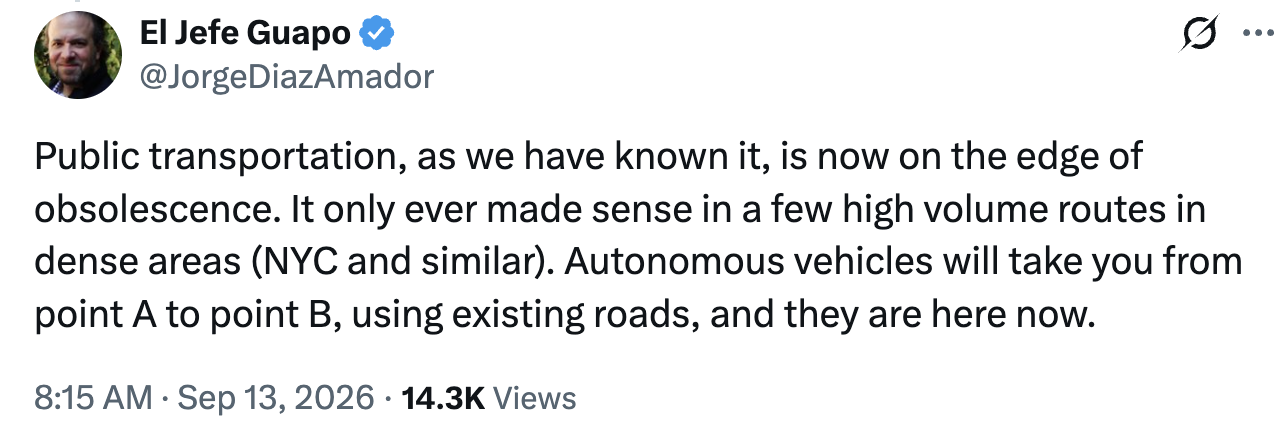
(The author of this post appears to work in optics for Tesla’s autonomous vehicle technology.)
If you recoil from this idea, let me assure you that it is very, very compelling to many people. In many transport-technology circles it’s taken for granted. It also resonates generally with the daily life of many people who live in the suburbs, see mostly empty buses go by, and have used autonomous taxis enough to see their potential. An argument that generally resonates with someone’s experience is going to be more powerful, no matter how wrong or misleading it is.
So I want to lay out, as respectfully as I can, all the ways this argument is wrong. I hope this is useful for you as you engage with this argument in your own conversations.
- The argument does not apply to dense cities, where the defining problem of transportation is how to share a limited amount of space. Autonomous cars use this space very inefficiently, just as all cars do. Every dense city will find that it has to limit the use of cars of all kinds because there is simply not room for them all if everyone uses them. This can take the form of (de)congestion pricing as well as the creation of more space for non-car modes to travel (bus lanes, bike lanes etc.) In dense cities, if everyone uses a car, nobody moves. It doesn’t matter that the vehicle is autonomous.
- It doesn’t even apply to longer journeys across large suburban regions, for the same reason. Dense cities will always be plugged with as much traffic as they make room for, because density means that many, many trips are arriving and departing on each block all the time. Across larger suburban regions, though, freeways that concentrate long-distance traffic also fail if they are the only means for going such distances. Many suburban areas with generally low density have manageable traffic on their streets but terrible traffic on their freeways and on the approaches to them. Autonomy is not a solution to this problem. The problem is cars and the lack of alternatives to them.
- Autonomous vehicles are “here now” only in certain cities. The problem of winter driving continues to be a challenge for them, although it is certainly being worked on. Small cities and rural areas, where otherwise isolated people could benefit most from autonomy, appear to be last in line because the companies promoting these services want the mass usage that only cities can offer.
- Autonomous vehicles are not “here” for persons with lower incomes, and it’s not clear they will be. In theory, the removal of drivers from taxi operations could dramatically reduce their cost and thus their fares. Elon Musk has made this claim explicitly. But Electrek’s analysis estimates Tesla’s hypothetical New York City robotaxi at around $0.66/mile versus NYC transit’s $0.34/mile — still much cheaper than Uber, but not actually competitive with transit fares. Waymo currently costs about the same as Uber and Lyft, if not a little more, so it is not an option for a very large share of the population, many of whom find transit a more cost-effective choice. Nobody really knows when or how fast the price will come down.
When the argument turns to this last point, affordability, a lot depends on exactly how financially comfortable people think about those who are less comfortable. It is very common, especially on social media, for people to pontificate in ways that suggest that people with low incomes are just not visible to them. These attitudes have several strands, and when you hear someone talking this way it’s important to delve and understand which kind of misunderstanding is at work:
- Elite projection is when fortunate people refer to their own personal experience as though it was a good guide to how everyone makes decisions. It is very common in the way that many fortunate people think and talk, especially in the US. Elite projection is mostly an innocent lack of awareness and needs to be confronted gently, without the assumption that the people who do it are bad people. I explored this crucial factor in detail here.
- Viewing transit as a charity for the unfortunate is a little better, because at least the low-income person is being seen. This tends to show up in the attitude that transit should exist because we vaguely care about those people, but that we should spend as little as possible on it and not care about the customer experience.
- Generalized conservative hostility toward low-income people, often accompanied by various stereotypes about them, is also common enough but I don’t worry about it. People who have such hardened attitudes are very far from being a majority, even if they often seem to dominate social media.
What all these views miss is the ways that a city that respects people with lower incomes works better for everyone, including the most fortunate.
- Lower-income people will generate traffic congestion if you force them to. Some of them aspire to own cars as soon as they can, but many buy cars because there is no viable alternative where they live. Car ownership rose in the late-2010s in many US cities, partly because especially favorable loans were being offered. Low-income people can also draw on informal networks, such as getting a ride from a friend or relative. Note that these “chauffeured” trips can generate even more congestion than the person driving alone. A common example: Mom takes their kid to school, making a round trip from home to school. They go back in the afternoon to pick them up, generating another round trip. That’s twice as much driving as if the kid had driven themselves. Good transit systems enable people to make other choices that reduce traffic congestion that affects everyone.
- Lower-income people’s ability to participate in the economy benefits everyone, not just themselves. Low-wage jobs need to be filled and they are often far from where a person making that wage can afford to live. Transportation problems are a top reason for not holding a job in the US. The resulting unemployment is a drag on the whole economy and on social services that all taxpayers pay for.
Seeing this requires seeing the diversity of people with low incomes, who make many different choices in the same situation. That’s why I push back against almost all generalizations about such people. The term “transit dependent”, for example, is very misleading. Low-income people themselves often describe themselves as “dependent” when defending a service they use, but it is equally important to stress that without the service, people will adjust their lives in other ways that will create other problems, and not just for them.
Arguments about transit often appear to be about technology but often mask an attitude toward less fortunate people, and the original post I quoted above is a good example. To say that autonomous taxis are “here now” is to say that they are here for the people who matter. So always ask: Who is being excluded by this seemingly appealing argument. It goes back to that ever-useful adage: In whatever room you are in, ask: ‘Who is not in the room?’
How do you see tolls, whether for (de)congestion in city areas or on freeways surrounding cities, playing a role in US and Canada transportation policy? If they are to play a role, how do you see policy builders framing them as beneficial?
Also, in the section “Car ownership roles in the late-2010s in many US cities,” did you mean rose?
I enjoyed the post, thank you!
Typo fixed, thanks.
Yes, all tolls discourage driving so regardless of their stated purpose, they count as decongestion pricing as long as there is an alternative mode such as a parallel transit line.