
Bogotá’s famous Bus Rapid Transit system, TransMilenio, is a quarter century old. Last month I finally had a chance to tour it, with my Colombian colleague Álvaro Caviedes and also with Professor Dario Hidalgo, a transport expert at Universidad Javeriana. I have some thoughts.
This article is in two parts. This first section is a more general introduction and includes a tour of the infrastructure and a review of the current debate. The second part, which is here, digs into the problem of service complexity, which I think is an underappreciated cause of many of the problems that people are complaining about.
Table of Contents
Introduction
Bogotá, population 10 million, has no rail rapid transit. Instead, it has TransMilenio, Latin America’s largest Bus Rapid Transit network. It was groundbreaking, but in many ways it’s no longer working well. It’s overcrowded, it has security issues, and it’s also easily disrupted by demonstrations or civil unrest. Arguments rage about whether these problems are fixable within the current infrastructure, with many voices just hating “TransMilenio” and everything the name connotes. Customer approval has been dropping, though it has recently begun to recover a bit.
Car ownership in Bogotá is below 20%. So when we talk about Bogotá’s public transit we are talking about the primary arteries by which the city functions. So it’s not surprising that almost everyone in Bogotá has fierce opinions about transit planning.
Decades of debate about whether and how to build a metro have at times caused TransMilenio expansion to be deferred, so the current extent of the network is less than half of what was originally planned to be done by now. Today, the first metro line, which will be fully automated, is finally under construction, but it’s just one line in a vast city with desperate public transit needs everywhere.
This is the first of two posts on what we can learn from Bogotá. This first post looks at the big picture and provides a tour the infrastructure, which is what most visitors notice and most experts write about. I offer this to orient readers who may be unfamiliar with the city and its network. But my real interest and most useful insights are about the patterns of service, which is the topic of the second post.
Remember: Infrastructure helps make patterns of service possible, but it’s the patterns of service (routes, frequencies, etc) that determine when you’ll get where you’re going. This is the most important way that public transit is not like roadbuilding or architecture. Build a road or a building and then you can use it. Build a train line or a busway and it just sits there until you figure out how to run trains and buses in it, and decide what patterns the service should follow. Because roadbuilding and architecture are more prestigious professions than transit planning, we have lots of people speaking with authority in the transit planning space who aren’t really focused enough on how the service works, and who will even make decisions that sacrifice the service for the sake of the infrastructure. (This is a global observation, true of every one of the 100+ cities I’ve worked in, not just a comment about Bogotá.)
The Infrastructure
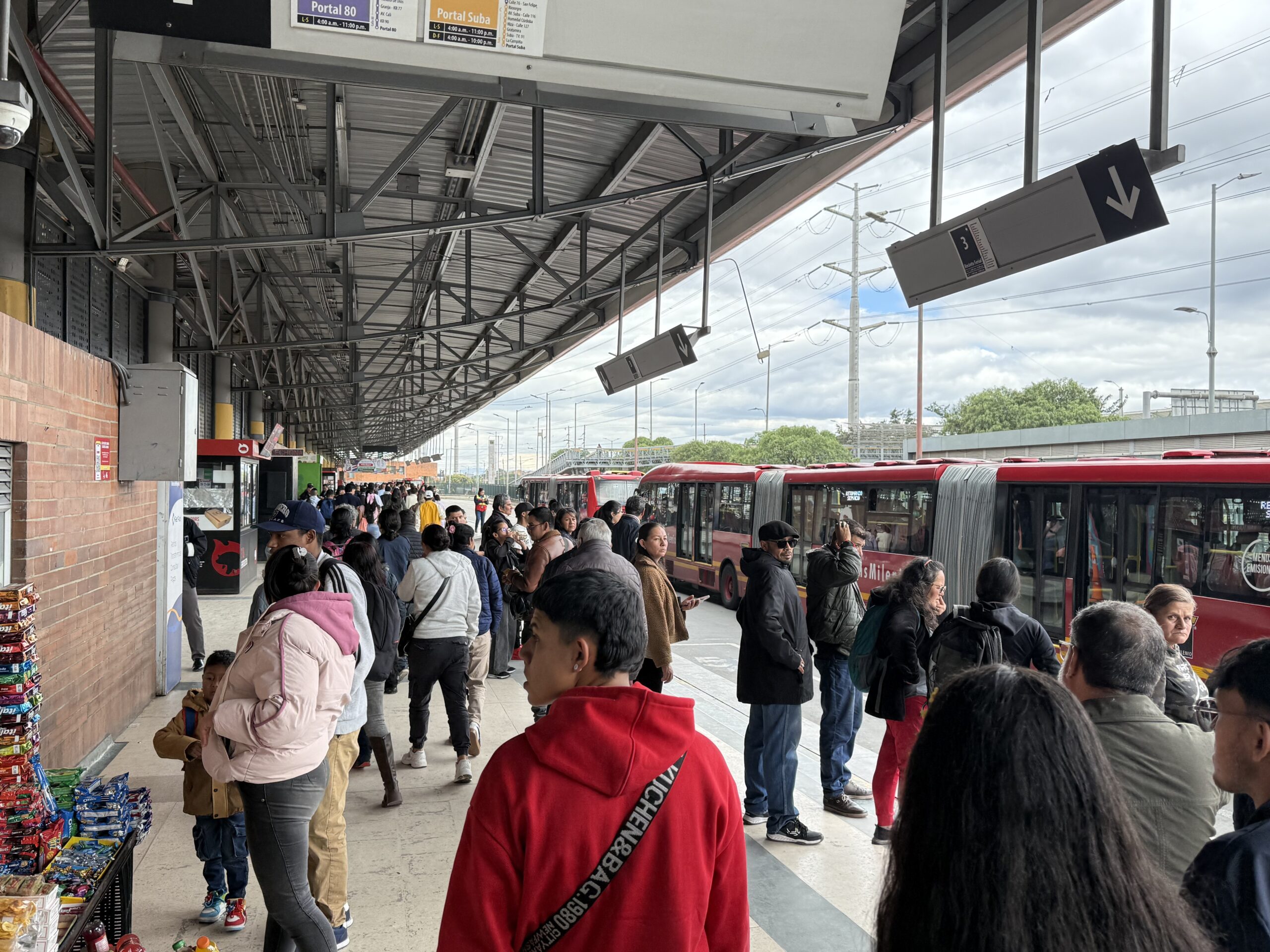
Most of TransMilenio consists of a median busway built into a wide arterial street, as in the picture above. The median stations are served by very large buses (27 m or 88 feet) with doors on the left. Stations have two bus lanes in each direction, so that buses can pass other buses. This is an important part of how TransMilenio can push such high volumes of buses through the system, which is the key to its incredible capacity: Its theoretical maximum is 56,000 people per hour per direction (phppd) and the highest observed on its busiest segment is 43,000. This puts TransMilenio ahead of every rail rapid transit system in the US and Canada except for two segments in New York City. It also stacks up impressively against many metros worldwide.
Of course, this is measuring how many people move through the infrastructure, not vehicle capacity or the efficient use of staff. TransMilenio buses are huge but much smaller than trains, so the number of employees per customer is much higher than in rail systems. This model would not work on this scale in wealthy countries where labor is expensive, but in Colombia’s middle-wealth context it pencils out.
Still, the infrastructure also presents many challenges. It was built into big boulevards because that’s where there was space, but this does not put the stations in the centers of active, dense communities as an underground system could. (Montevideo is now developing a BRT system with underground stations in the city center.) How do people get to stations in the middle of vast boulevards? Large pedestrian bridges are the usual way, but the result is a long walk. It can be over 500m walk from a station to the nearest place that anyone might be going.

TransMilenio’s own offices experience the worst of this problem. They are in a building on the right in the photo below. They have a nice view of the station, which is at the end of the walkway in the median, but their walk to to that station is nearly 1 km, via the pedestrian bridge where the photographer is standing:

TransMilenio stations are fully controlled. You go through a turnstile to enter them, and then, well, you’re in a crowded metal cage in the middle of a highway.

A lot of effort has gone into keeping people from running across the road to the platform to evade the fare, which led to the “cage” effect.
At major junctions, the stations are much more spacious.
Is there beauty in the system? Yes, in a few connection stations that involve underground pedestrian links, nice things have been done with artwork.


There’s also a beautiful segment in the city center, a rare case where TransMilenio has an entire surface street to itself. (Still, you can only board at the fare-controlled stations.)


The station cages tend to get crowded because the service is complex, with many patterns of service stopping at each station. For this reason, people aren’t motivated to get on the next bus that comes. The result is more waiting, and more crowding, in the stations. I’ll explore this issue in the next post.
The Buses
TransMilenio’s busways are served mostly by double-articulated red buses, designed to manage huge crowds. Because you pay your fare in the station, you can board or alight at any door. These buses are almost always crowded. At one point, Professor Hidalgo and I were discussing what an appropriate standard for crowding of standing passengers should be. We debated whether it should be 6 people per square meter or maybe 8, even as we were smashed together in a crowd that was clearly over 10 people per square meter.
There is also a range of other bus types. Buses that are partly red and partly green or yellow run on some part of the busways but then leave them to run along normal streets. There are also feeder buses, which tend to be green, and a range of other local buses, often blue. Feeders often have extensive infrastructure built into major hub stations. In this photo, the sign indicates that this bank of turnstiles is for exiting the area of the green feeder buses, not entering it. Unlike most buses running on normal streets, green feeders don’t have fareboxes, because they assume that everyone is traveling to or from a station and will therefore have to go through these turnstiles.

The blue buses mostly remain outside the TransMilenio infrastructure, running on local streets, so these have fareboxes with turnstiles onboard.
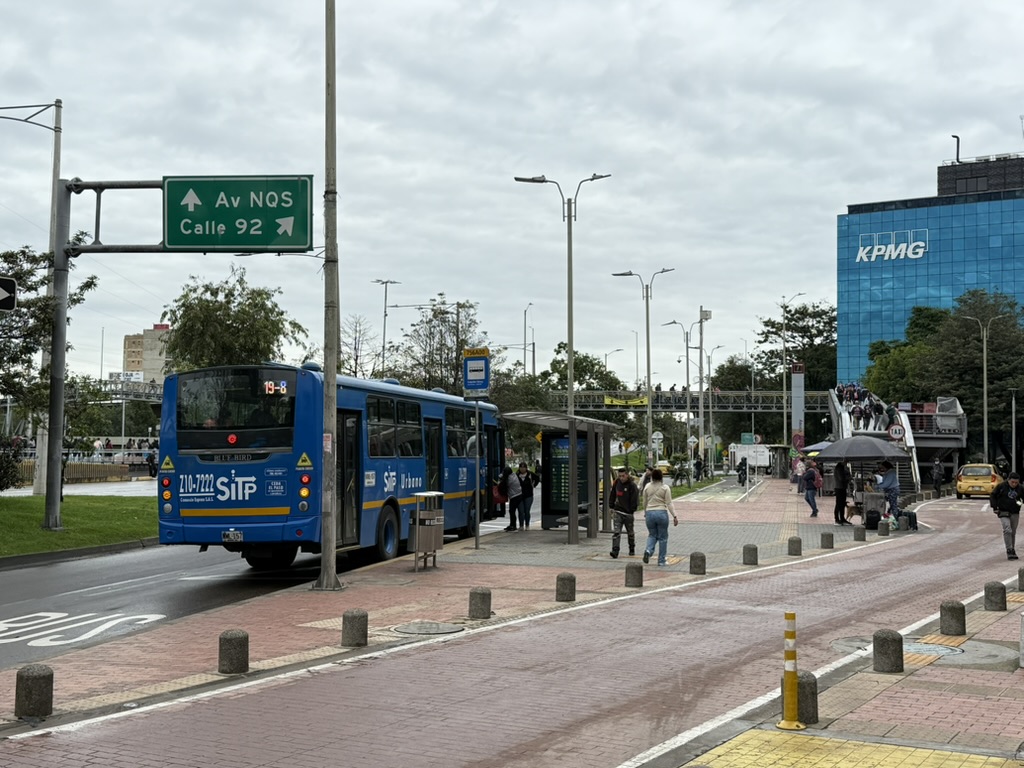
Finally, many TransMilenio bus routes leave the infrastructure to continue on local streets. This is one of the great strengths of Bus Rapid Transit compared to rail. When you get to the end of the rails, everyone has to get off, but buses can continue to reach more destinations without requiring a connection. However, they sacrifice reliability and legibility when they do this, so it needs to be done carefully. I’ll return to that problem in the next post.
Recriminations, Gratitude, and the Metro Debate
It doesn’t take much exploring on Bogotá social media to find great masses of people fulminating about TransMilenio. From the beginning, TransMilenio has been haunted by the infrastructure that it isn’t: A system of rapid transit trains, or “metro” in the local parlance.
Bogotá (population 10 million) is by far the largest Latin American city without any kind of subway or metro system. The next largest, Curitiba in Brazil, is barely a third the size, and was one of the earliest pioneers in using Bus Rapid Transit as an alternative to heavy rail. So this has long felt like something that Bogotá got wrong. It’s easy to argue that the inventors of TransMilenio imported a concept from Curitiba into a city that was just too big for it, and that they should have been building a metro from the beginning.
But metros are so expensive that if they had gone that route, they’d have a less extensive network today, reaching fewer parts of the city. They finally are building their first metro line, and planning the second, but it will take a long time to approach the scale of TransMilenio’s infrastructure, which has 113 km of busway spanning much of the city.
This is important because Bogotá has huge transportation needs. Like many cities, it has evolved a development pattern where many people, especially lower-income people, are very far from the opportunities they need. So while TransMilenio is crowded, awkward to access, and a bit depressing at times, it is vastly better than what was there before: a tangle of confusing privately-provided bus services that sometimes raced each other in the competition for passengers. This mural gives a sense of what that felt like:
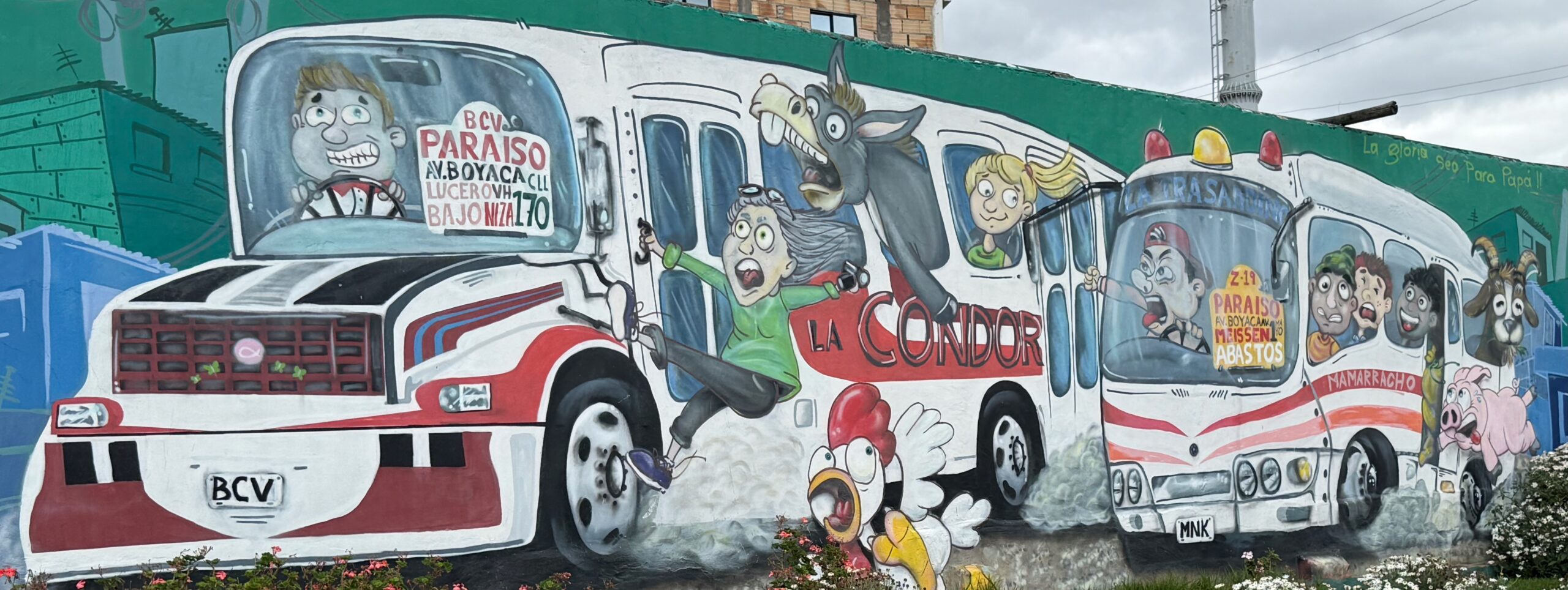
Mural at El Mirador, Ciudad Bolívar
There will be no end to the debate about what should have been done in the 1990s, when the TransMilenio decision was made. Leaders at the time chose a citywide network that they could stand up in a decade, rather than a much smaller rail transit network that would only have further polarized the city between winners who could use it and losers who couldn’t. Now, Bogotás busiest corridors have outgrown TransMilenio and the metro is starting to appear. The challenge leaders face now is to keep TransMilenio’s expansion going even as they add metros to the network.
But that’s not their only challenge. Bogotá faces an equally consequential challenge in the staggering complexity of its public transit network. This too is a major reason that traveling around the city can be so difficult. The next post looks at that challenge.
Eager to read your second post. Great analysis so far.
It’s here! https://humantransit.org/2026/03/bogota-the-price-of-service-complexity.html