Very bad transit service cuts are coming to Portland.
Just a couple of years ago, we worked with Portland’s TriMet to develop an ambitious service expansion plan called Forward Together. Now, the agency is saying instead that they are facing a dire financial shortfall and need to make service cuts. I’m not sure why this message has changed so suddenly, apart from the failure of the state legislature to provide a new funding source for operations. In any case, the agency’s current position is that they have to cut service now to avoid worse cuts later, although worse cuts may be coming later anyway.
You can peruse the cuts here. If you live in the region, you should comment before Saturday, January 31.
I have several thoughts, which are further below, but it’s best to start by looking closely at the single most shocking cut they propose.
Abandoning a Major Hospital?
This may well be the first time that a US transit agency has proposed to abandon all service to a major medical center: Providence in inner northeast Portland. It happens to be a landscape I know well. I live nearby, grew up even closer, and go to the Providence complex for most of my healthcare. Also, I first moved to Portland in 1969 (I was 7, but already a transit geek) so I know some useful history.
This part of northeast Portland is a fairly dense area with a good street grid where a lot of housing is being added along frequent transit corridors (red in my sketch, which is based on a Remix plot):
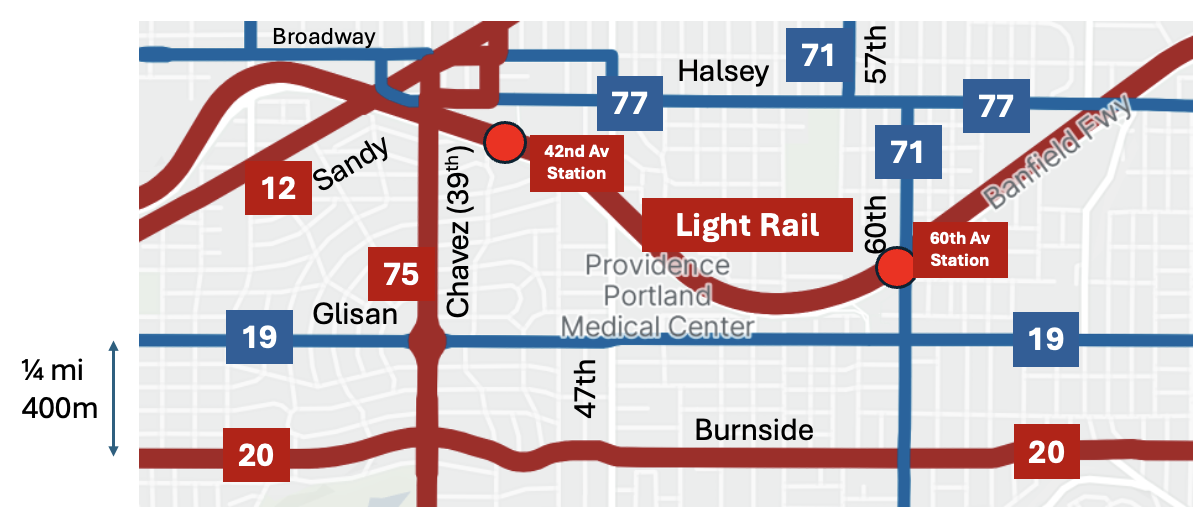
In this inner-city context, most of the blue lines, which currently run every 20-30 minutes, should be every 15 minutes, because they can perform well as part of a frequent grid. But in fact only the red lines are frequent. There’s also the sinuous light rail line, following I-84, but it only has two stations in this area, at 42nd and 60th. Do not ask me why there is no station at Providence, whose campus lies between 47th and 52nd right next to the rail line.
Now, TriMet proposes to entirely delete Line 19 on Glisan. This would remove all service within 1/4 mile walk of the Providence complex.
I was an intern at TriMet around the time of the 1982 redesign that created the current grid. At the time, all the lines on this map were made frequent (every 15 minutes or better) except for Glisan. The network is designed mostly around the principle of 1/2 mile spacing between lines, because many people will walk up to 1/4 mile to useful service. Glisan is only 1/4 mi from Burnside, too close for both to be frequent (at least in the context of the scarcity of service that is typical in the US).
Glisan is a mixed bag as a transit street. West of Providence, the neighborhood of curving streets is Laurelhurst, an area of low density and hence low demand. But Providence itself is a massive complex, a major hospital and a large building of medical clinics where many people come for appointments. Further east, beyond 60th, Glisan is a better transit street than Burnside for a while: it has a grocery store and apartments in this segment, while Burnside is climbing over the north shoulder of Mount Tabor, which limits development potential there. But long ago the decision was made that Burnside, not Glisan, would be the Frequent Service street, where TriMet would protect 15 minute frequencies at most times of day.
Now, if TriMet has to remove the 19, all the options are truly hideous. Abandon Providence entirely, along with the moderate income area and moderately dense area along Glisan east of 60th? Deviate the Halsey line (77) down to Glisan, just between 47th and 60th, to touch Providence, making it longer and thus less useful for through travel? Deviate the Burnside line up to Glisan, violating the principle that Frequent Service lines should aim for permanence since they’ve been used as the basis of dense housing development (including some on the segment that we would miss if we deviated in this area)?
I don’t know what TriMet will do. I don’t know what I’d recommend, except to say that a city with Portland’s pretensions to sustainability should not be in this position.
The Overall Design of the Proposed Cuts
The fact that service is being cut is a financial decision out of the control of TriMet’s service planners. Given the direction to make harmful cuts, I think they’ve done a good job in minimizing the harm. Some things I especially respect are:
- Sharing the pain with the light rail network. Until 10-20 years ago, many agencies would have started this process from the assumption that the rail service is special and must be protected, leading to even more destructive cuts to bus service. Instead, TriMet proposes to cut back the Green Line to just its unique segment south of Gateway, where it would operate as a feeder to the Red and Blue lines. This is a frequency gut cut all along the east-west segment now served by Red, Blue and Green (from 5 min to 7.5 min) but it’s also a cut to north-south frequency along the transit mall in the heart of downtown, from 7.5 to 15 min. A 15 minute frequency is really not relevant to internal circulation in a downtown, serving trips of under 2 miles, and the whole design of the transit mall (as redone in 2008) presumes that rail, not buses, serves this circulator function. Now that won’t work at all. So yes, a terrible cut at the heart of the system. But light rail operating costs are high, and if they didn’t cut light rail they’d have to utterly devastate the bus network.
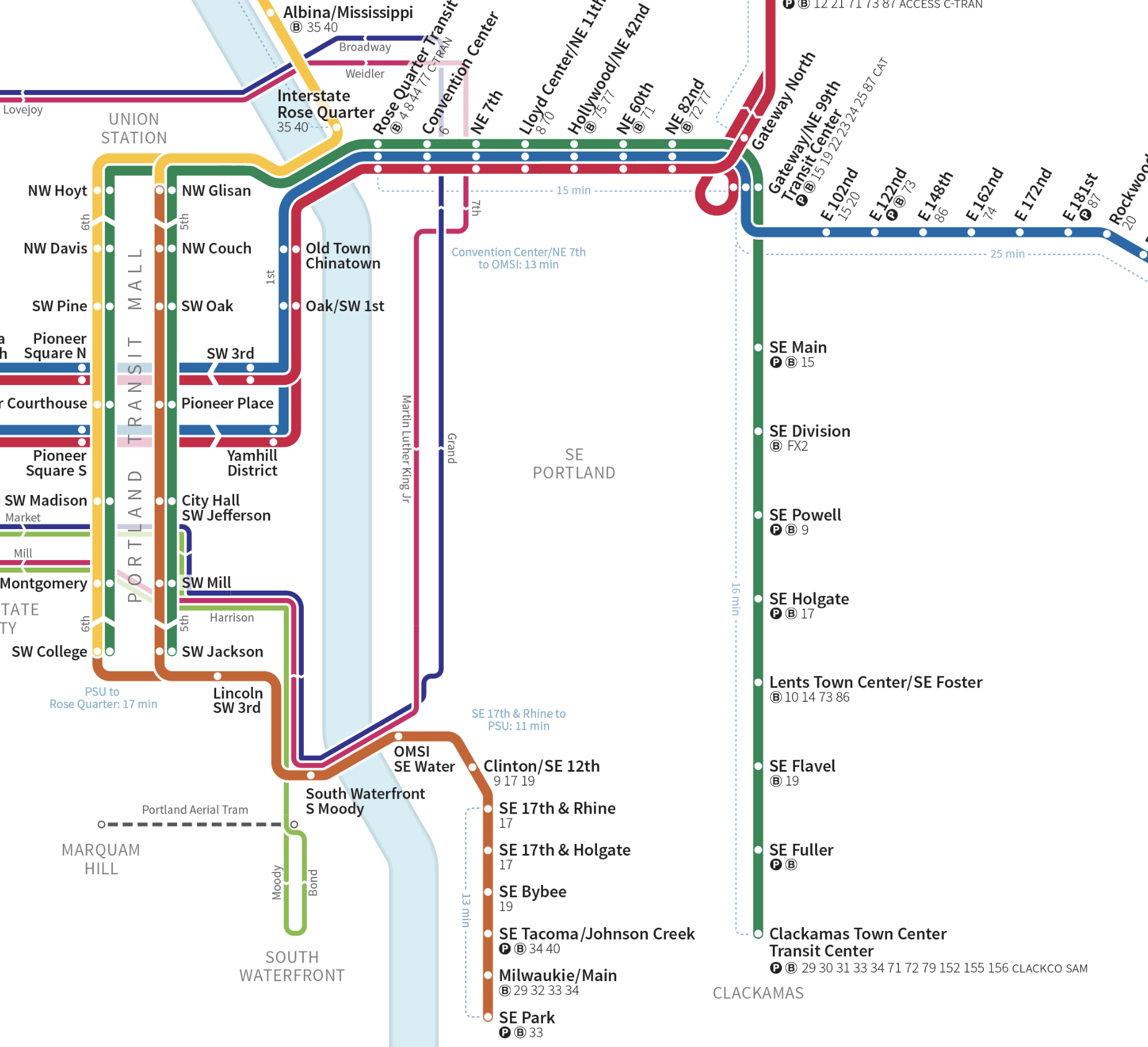
- Some service designs that are improvements. Our Forward Together project included many ideas that have been carried forward here, though without enough frequency. (Continuous service the whole length of Woodstock Blvd, for example.)
- Balanced removals of coverage. The principle of the Forward Together project, as endorsed by the agency’s Board, was that service needed to be justified by either ridership or equity. That means that low-ridership service can be offered only where it responds to a demonstrated social or economic need. As part of the Forward Together plan, TriMet has already deleted low-ridership “coverage” services in relatively affluent parts of the region, and they continue to do so in this proposal.
But overall, the plan’s impacts are dire.
What’s more, there’s a serious risk that in the public outreach process happening now, more people will defend the deleted routes than defend the Frequent Service network. This could pressure TriMet to cut frequencies on this backbone of the region. We have already done this experiment: In the 2009 financial crisis TriMet cut Frequent Network frequencies from 15 minutes to 16-17 and triggered a dramatic loss of ridership. Frequency is never visible enough on the map, which makes it hard to defend when people are complaining about losing all of their service, yet frequency is the key to ridership. This is the eternal ridership-coverage tradeoff.)
Do We Really Want to Do This?
Oregon’s legislature recently went through a spectacular failed effort to pass a statewide transportation funding measure, where rural legislators demanded maintenance for their roads but were eager to strip out transit operating funds for cities. A measure passed that funds transit only through 2028, but that has been referred to the voters, with an election scheduled for May.
It seems likely that the best we can hope for from the state is a short-term rescue. Leaders in the region — probably working through Metro or the City of Portland — are going to have to step up if they want to save what was once one of America’s most admirable transit agencies.
I think the Green Line to downtown is a mistake personally. Trimet hedged, in part, with the FX-2 line as a quickish option from SE to downtown. The agency already tipped their hand (perhaps your firm is involved?) with the desired Teal Line running the full course of the 205 transit-way from Clackamas to the airport. A clipped Green to Teal seems like an excellent first foray into non city core LRT service.
I read some recent rumblings that 19-Glisan might be saved by PCEF funds, if the mayor and council can get a ruling on whether the climate funds would be eligible to use for operating expenses. I can’t think of a better immediate way to buoy the core city commitment to car free lifestyle as Salem gets its act together.
I don’t think we can count on “Salem” getting its act together.
Why in the world would you cancel line 19 which runs in front of a hospital? This is insanity. Someone who, may be sick or injured, doesn’t have access to a car would have to walk 1/4 to 1/2 a mile more to get to Providence. It is not only insane, but heartless.
No, it’s not heartless. It’s an expression of how bad TriMet’s options are.
Hospitals in the USA are not friends of transit so Providence probably is not protesting. They care about parking for their upper middle class employees, regular workers and patients not so much. Duke U hospital killed an LRT as you know. U Penn hospital complex is building a thousand car parking garage. SEPTA already has to go behind parking garage for their high income workers.
Is TriMet cancelling bus 19 to Mt Scott also? The 19 Glisan relieves crowding on both MAX Blue line and 20 Burnside bus.
The 19 Glisan may be relatively lightly used but as you note cancelling direct TriMet bus service to Providence Portland Medical Center would be a real and painful loss and be further evidence of staggering decline in Portland’s standard of living.
The city is already a shadow of its 1985 to 2009 halycon days of ballyhooed livability
Nice piece, cheers.
A minimal service by a revised Line 10, a few trips a day, would go to Mt Scott. But a continuous Woodstock line to Lents is also proposed.
(With acknowledgement that the only real way out of this mess is proper funding for transit…)
One idea for salvaging service on the most essential portion of NE Glisan, including access to the hospital — extend #25 bus (which services Glisan east of Gateway) west to Cesar Chavez Blvd and terminate at Hollywood Transit Center/MAX station. The remaining segment of the line that would lose service is the part with the best alternatives (#12 and #20), and the #19 and #25 already have schedules and service levels which closely align. (So close, in fact, that they might already be interlined in practice, but I don’t know for sure.)
Im a Tri Met Lift rider and a legally blind woman. I want to know which routes will be taking away from us Tri Met Lift riders. Thank you.
You have a civil right to Lift. It cannot be taken away as long as there are fixed routes.
According to Trimet’s service changes page, there would be some very minor reductions in LIFT service area, where deleting lines changes the LIFT-service boundary:
“Eliminating lines 82-South Gresham, 97-Tualatin-Sherwood Rd and 153-Stafford/Salamo, as well as 76-Hall/Greenburg Rd service between Tualatin, West Linn and Oregon City, changes the LIFT boundary. These changes affect fewer than 0.5% of trips on LIFT.”
19 was my only hope at getting home today. Had to wait 20 minutes for it to arrive. Not sure why they would cut that one. Its the only one that goes from gateway to where my building is. Funny thing is the line way out by my work runs every 15 minutes. Only had to wait 3-4 minutes for that one. I think he is right with 19 being a frequent route business would pick up. Who wants to wait 20 minutes in the cold windy rain at an uncovered stop when you can walk a couple of blocks and catch a frequent bus?
Personally I use the 19 very frequently it’s easily accessible and I really don’t want to see this bus line stopped there r other buses that could be brought more updated routes
Great article! We emailed Trimet, and here is what they’ve shared with us:
Question: In terms of ridership, how does the 19 route stack up relative to other routes?
Answer: We developed this proposal with the goal of hoping to reduce costs while still largely serving the same areas. The Glisan stretch of Line 19 is proposed for elimination not because of its ridership but because service is available nearby with Line 20 one quarter mile away and in some cases like at 60th there are also MAX stations nearby.
Question: Given 19s direct access to a providence hospital and Fred Meyer, and the affordable housing development at 74th and Glisan (designed specifically with the provision that it has easy access to public transport) why was the choice made to cut the 19 instead of the 20?
Answer: Burnside is around a half of a mile from Belmont. Removing service on Burnside would result in a gap between Glisan and Burnside of nearly three quarters of a mile. Whereas the gap left by removing service on Glisan would be smaller.
Question: If cutting the 19, was any consideration given to rerouting 20 slightly such that it can better serve these core amenities in the the Montavilla neighborhood in the absence of the 19?
Answer: It was considered but Line 20 starts in Gresham and serves key destinations such as Mount Hood Community College. Deviating that route to Glisan would add travel time for riders of that route and would still create the gap I described in my response to number 3.
All good answers, which I agree with. It’s a terrible situation.
Not enforcing the rules and allowing homeless addicts to use the max as a free, warm drug den has chased away most of its suburban customers. Combine that with downtown crime decimating business and retail downtown and you have a life-threatening self inflicted wound. Is anything left downtown worth exposing your family to fentanyl?
People in Portland develop the ability to distinguish inconvenience from danger. Crime is down, but it will never be possible to reassure folks from the suburbs who are being fed anti-urban hysteria by the right-wing media.
I am a suburban customer who has ridden TriMet regularly for 20 years and never felt unsafe. I used to travel a lot for work and would often catch the last Red Line train out of the airport at 1am. And I go downtown frequently now and don’t feel unsafe–and frankly don’t see any more disorder there than I have ever seen. As Jarrett says, the media constantly feeds us anti-urban hysteria–and it’s not limited just to outlets that are labeled as “right wing.” Any time there is any kind of crime or disorder on public transit, it is breaking news at the top of the hour on local news–despite the fact that 10 similar crimes probably happened that same night in suburban parking lots, on streets, or inside private cars that got no coverage.
I had not heard of the Teal Line idea before but have always thought that would be a good service. But it’s interesting that they decided to lop off the Green Line right after extending the Red Line further west into Hillsboro. It seems to me that the most sensible first cut to the MAX system would be paring the Red Line back to Beaverton TC (or even going back to having it turn around downtown). But since we just used federal funding to extend that line a year ago, I assume they contractually can’t do that. I live on the west side, and in a previous life I traveled a lot and made the transfer at Beaverton TC to get to the airport. The Red train was always waiting there and it was an easy connection. I do know that would reduce frequency on the west side, and I have appreciated having 7.5 minute headways. Another idea would be to keep the MAX lines as they are, but increase the headway of each line to 20 minutes. Areas where two lines run together would still have 10-minute headways. But Jarrett is right that it is embarrassing that Portland is in this position.
Americans needs public transport, this is why l moved to Portland, it is one of the better American cities for this. But if they make these wretched cuts that would be awful. I use it daily, l left feedback on the “service cut” website, l would attend an open house but they are all during the day when l work.
An ‘easy’ solution might be for them to have the 20 bop over real quick onto the campus and back over to burnside – the same way the 20 does for the westside Providence.
I do not see how this “popping over” is “real quick”, especially for a frequent line that is very busy at that point. The 20 would have to miss Burnside all the way from 47th to 60th.
The other option is to split the 20 off into one branch that goes to the hospital and one that runs through, Minneapolis style with branches. I’d probably run the 20 branch that runs on Glisan between 47th and 82nd. The fact that a bus service may be branched is less important for ambulatory people alighting in the branched segment and while is annoying for someone in the middle section trying to pick which branch to board, can be mitigated with the apps that say where the next bus is. The other would be moving the 75 off to 47th instead of Chavez/39th to pass by the hospital, it’s just one additional turn since the bus is on 42nd north of the MAX station and there is a traffic circle at Glisan and 39th.
Agree. I personally have no problem using apps to see if it’s faster to walk 1/4 mile to the other branch. Did this often where I lived previously.
“The other would be moving the 75 off to 47th instead of Chavez/39th to pass by the hospital.”
This is a really intriguing idea that needs to be investigated. From a connectivity standpoint, there would obviously be a significant loss of convenience for those who currently use the 19 east-west, but the hospital would get much more useful service from a detoured 75, since it provides frequent-service connections to a vast swath of NE and SE via connections to multiple east-west frequent-service lines. (Whereas the 19 connects to far fewer north-south frequent-service lines.)
And as calwatch notes, it’s only adding a single turn and a few blocks additional travel distance, whereas the couple of stops it would miss on Cesar Chavez (Laurelhurst) must be relatively low-ridership. Seems like this would be an option to look into, even in the absence of service cuts.
This whole article is pathetic, narcissistic entitlement.
Buy a car, old man!
Stop demanding the rest of us to pay to supplement your basic travel needs when we NEVER ride the bus
Troll
The extreme cost of light rail has caught up with us and is now undermining the entire bus and rail network through service cuts which drives ridership lower as the author highlights. I’m baffled by the idea and costs of running light rail to Vancouver, which will bring this same issue to C-Tran. Bus rapid transit, like the Vine, requires significant less infrastructure investment, and allows future route flexibility.
Please don’t describe the current shared Red/Blue/Green segment as every 5 minutes. It’s every 3/4/8 minutes. Back in 2010 you wrote exactly about this in “The Perils of Succeeding “On Average””. A 3/4/8-minute service is not comparable to a 5-minute service, it’s more like “An 8-minute service with some extra trips”.
This is an inevitable consequence of the current service pattern, it’s impossible to have even intervals to both Hillsboro and Gateway. If you remove the green line, you will still have even 7/8 minute intervals on the segment shared by Blue and Red line. The frequency loss will be minimal
If the primary issue is getting people to the hospital, Providence could fund and run a frequent shuttle bus between the Hollywood TC and the hospital complex.