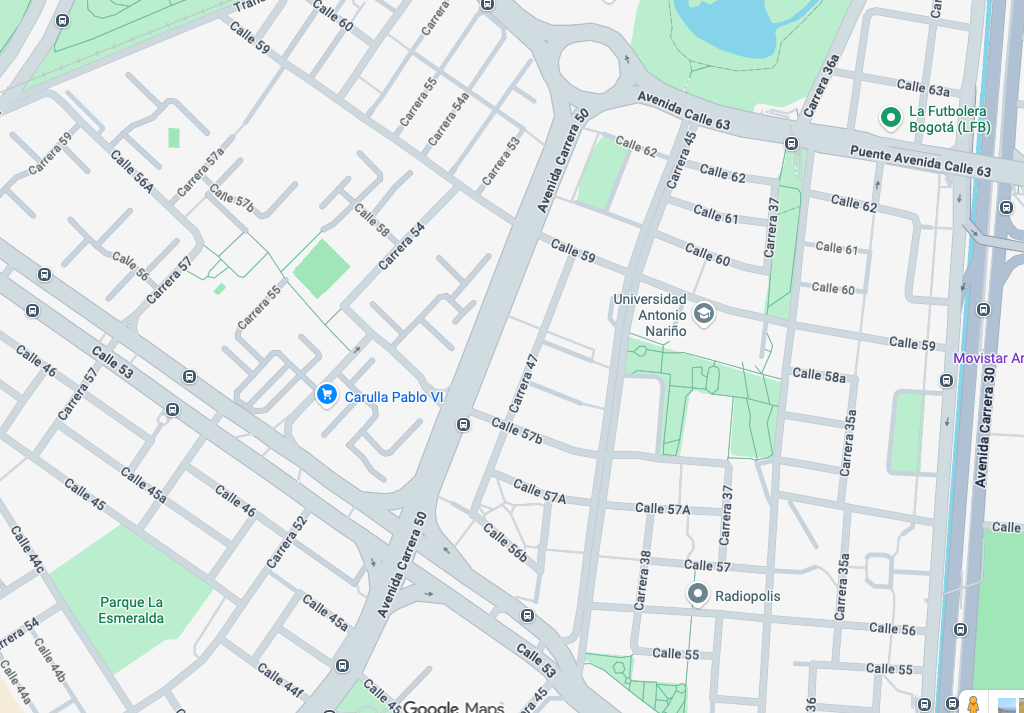
 I enjoy Europe as much as the next urbanist, but years of living and traveling there never uprooted one of my most unpopular opinions: Streets numbered in sequential order are a wonderful thing for the cities that have them. I was recently in Bogotá, Colombia and found that, while the city is as overwhelming as you’d expect a Latin American megacity to be, and the transit system is deeply confusing, there is a deep, comforting legibility beneath it all. Most streets are numbered, either as carreras (north-south) or calles (east-west). So most addresses are a simple pair of coordinates that give you a good idea of where a place is in the city. Wherever you are in Bogotá, you have a good sense of where everything else is, and how far away it is. They do this even though their local street networks aren’t always very gridded. The numbers create a larger web of legibility that always orients you, even if your immediate surroundings are confusing.
Salt Lake City and Manhattan are two other famous examples. What New Yorker hasn’t appreciated how you can quickly figure how far it is from 100th St 1st Avenue to 14th St & 9th Ave?
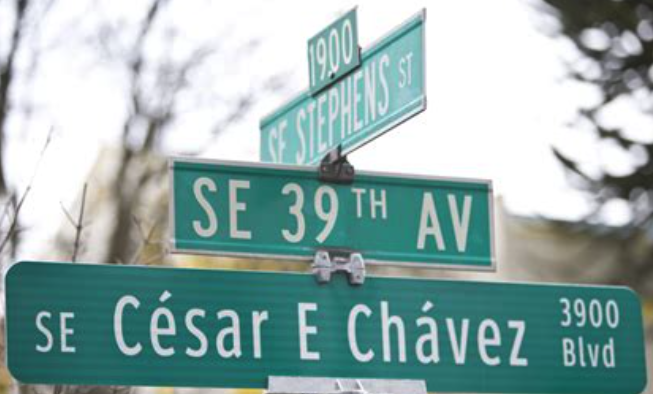
Here in the US, the scandal around César Chávez’s grave sexual offenses in the 1960s will require the rapid renaming of many streets names for the United Farm Workers leader. Here in Portland, our 39th Avenue was renamed César E. Chávez Blvd in 2009, so many people remember the old name.
Now that the name will almost certainly change again, I ventured a letter to the editor to the Oregonian advocating for returning to “39th Avenue.” They had me cut about half of it, so I thought I’d share the full thing here. I hope it’s relevant to you if numbered streets are part of your city’s heritage.
Call it 39th Avenue
Jarrett Walker
What should Portland do about César E. Chávez Blvd, which was 39th Avenue until 2009? The understandable first reaction is to rename the street for Dolores Huerta, Chávez’s partner in the United Farm Workers (UFW) who has now accused him of raping her in 1966. It feels like a simple way to continue honoring the history of the UFW now that Chavez’s name is toxic, by centering a female leader who was probably as important to the UFW’s achievements as he was.
But before we do that, we should think for a moment about what streetnames are for. They are for helping people navigate the city. And while Portland is used to a mix of names and numbers, numbered streets do that job especially well, because they tell you where the street is. They reduce the amount of information a person has to know to get on with their lives.
Nobody will go into the streets chanting in defense of numbered avenues, but our city would be much harder to navigate if every avenue had a name instead. Not impossible, bur harder. These costs tend to fall on people we don’t think about or hear from: recent immigrants and other newcomers, as well as visitors.
Naming a street for Chávez was obviously a mistake, based on what we know now, but renaming 39th Avenue was a different and equally important mistake, because the existing name was so useful. When we changed it, we made the city measurably less legible, which is to say, less welcoming. Maybe just by a little, but it made a difference.
There’s another good reason to hesitate before naming things for people, and it also applies to putting up statues of people. We can never know when a human hero will disappoint us. Historians dig up new things all the time, changing our view of past heroes we thought we knew. It would be folly to assume that in this moment when everyone is recoiling in horror at the revelations about Chávez, we know everything we will ever need to know to decide who deserves to be honored by a street name.
We should always be reluctant to change street names, not just because it’s expensive but because it adds to the work that ordinary people must do to go about their lives. Then there’s the specific burden on the people living or running businesses on the street. In this case, there’s no way to protect them now from a second change of name. Chávez has to go. But out of respect for people on the street who have gone through two name changes, we should at least choose a name that we know won’t have to change again, no matter what we learn about history in the decades to come.
Numbered avenues are a good thing, and so are streets named for plants or animals or landscapes. Human heroes may disappoint us, but math and nature never will.
How about 39 ave/Dolores Huerta street?
I totally agree and have long wanted Seattle to embark on a project of rationalizing its street and avenue names and its address numbers to create a clear, predictable order. I’m in the Netherlands now in a city that built enclosing walls in the 13th century, and once you have a medieval non-grid of streets, you’re really not going to change it. A sometime benefit is that bus stops can be named for the street they serve, since it’s rarer for one short street to have two bus stops. Seattle’s transportation will always be limited by water and topography, and I don’t propose to move streets or buildings–even the conflicting grids between downtown and the rest of the city (thanks, Denny and Yesler). But having lived for 6 years each in Indianapolis and Washington, DC; Seattle remains overly confusing and indecipherable for the marginal groups you cite. The numbered streets and avenues are useful to an extent, but the abundance of “zones” means they start and stop in unpredictable places and make it very difficult to measure distances across zones. The named ones, unlike DC, are in no discernable order. It’s easy to emerge from the DC Metro at Ordway Street and know you’re 4 blocks from Sedgewick. You also pass benchmarks along the way that confirm whether you’re going in the right direction (i.e. Quebec Street is the right way; Macomb isn’t). If you get off Link at Capitol Hill in Seattle, there’s no good way to understand that the avenues east of there are numbered, but not west of there. Nor are those western avenues in a useful order (Harvard, Boylston, Belmont) or any of the streets (John, Thomas, Harrison). This is fixable.
Also, CTA deserves a shout-out for using street grid coordinates at all its L stations. It makes it easier to know which way you’re going and where you are in the city.
1st Ave W and 1st Ave N running parallel two blocks apart on lower QA also known as Uptown where other numbered streets interlaced with named streets interrupting the sequence is one of my favorite Seattle quirks.
It makes some sense within the context of the 11 zones; what doesn’t are the 11 zones themselves. Many of the borders between zones, like Queen Anne Ave, are arbitrary and make little sense. Denny, Yesler, and the Ship Canal are a bit more understandable.