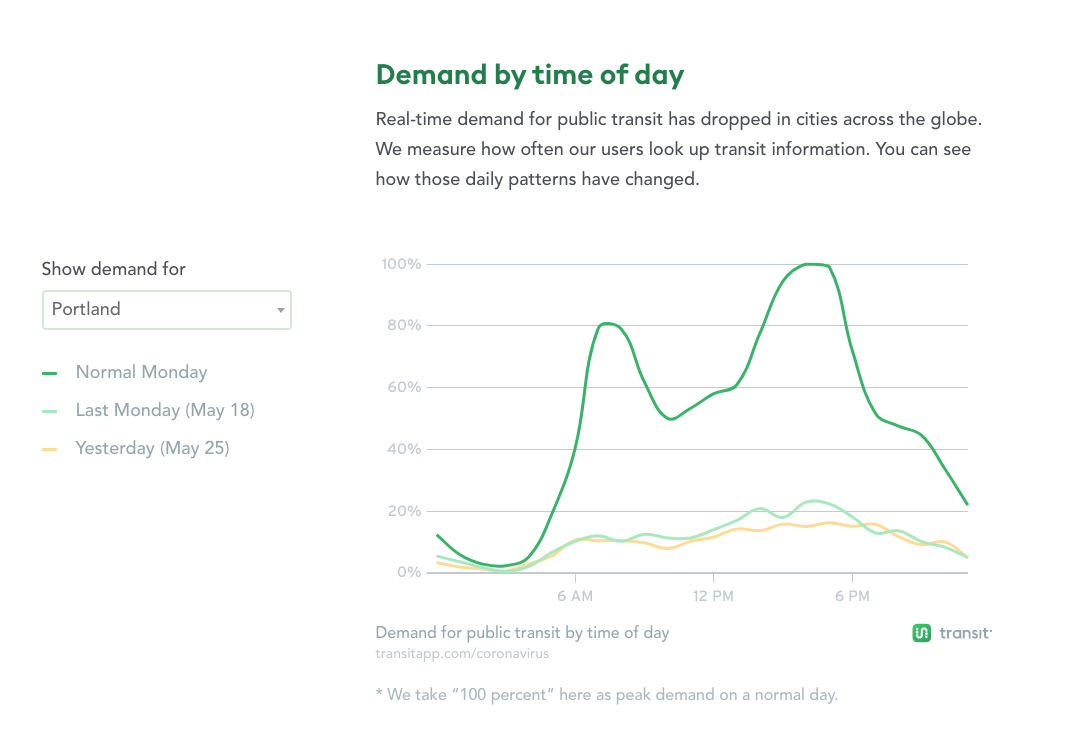
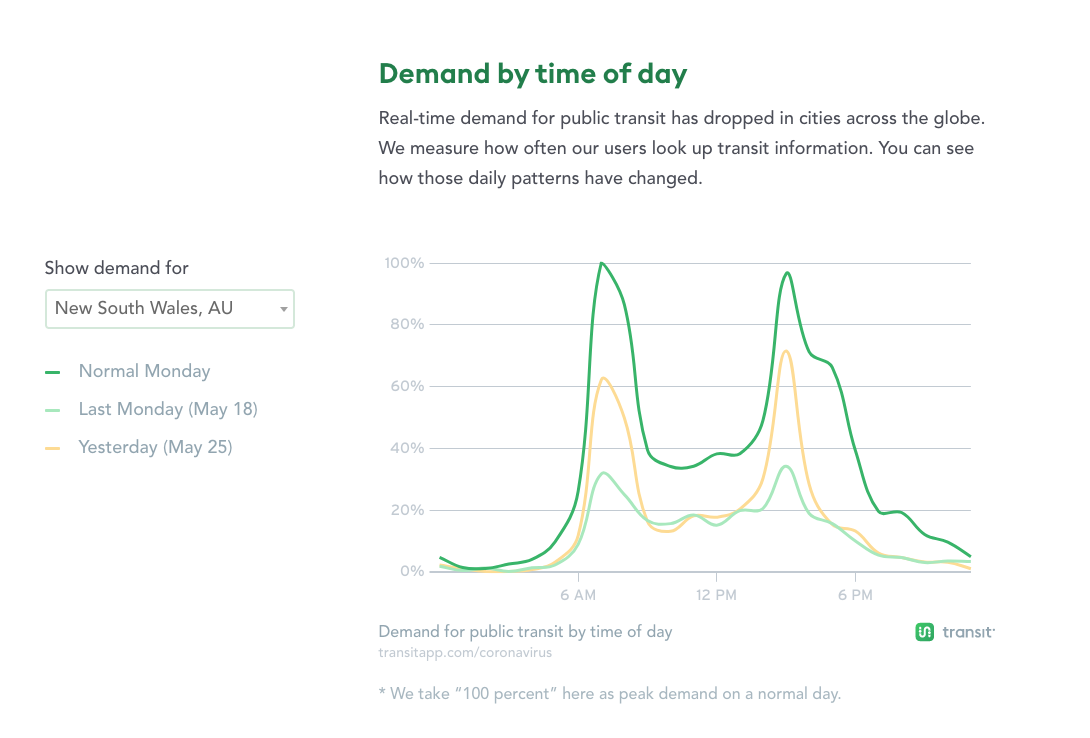
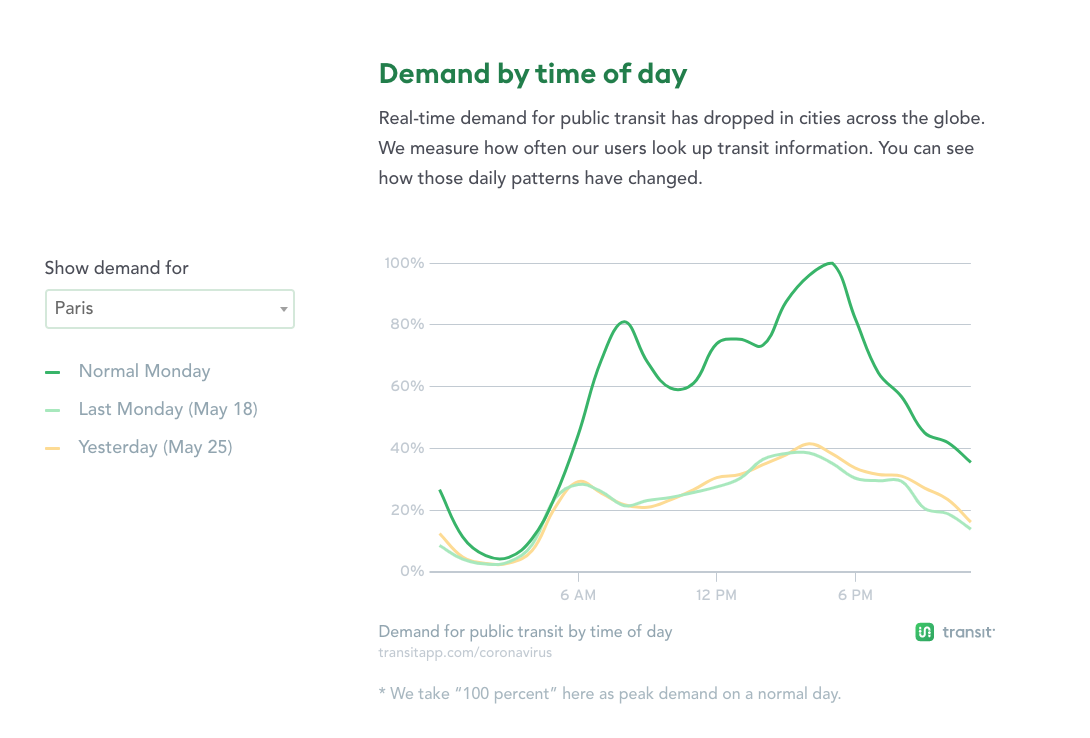
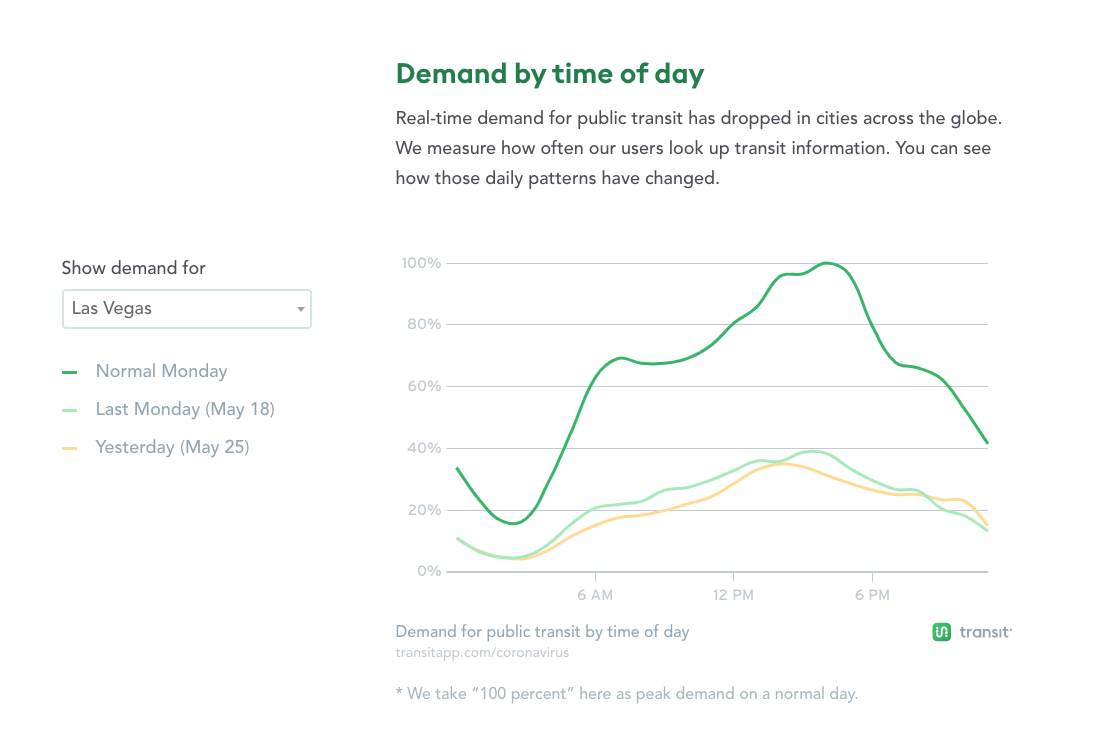
Cutting Transit Service During the Pandemic: Why? How? And What’s Next?

Most of the goals that we expect public transit to pursue have just turned upside down.  Ridership was an important goal two months ago, but now public transit agencies are telling customers to stay away if they can, restricting service to “essential trips.”  These trips are critical, though, to the functioning of society.  You could even argue, as I did in Citylab recently, that transit is helping prevent the collapse of civilization.

But now transit authorities are having to cut service.  This post examines why, and how they should do it.  It’s long, so there’s a table of contents:

Contents

  1. Why Cut Service?
  2. Why Not Shut Down?
  3. What Service Should be Cut?
  4. What Agencies are Doing, and May Do
  5. Three Stages of Adaptation and Recovery


1.  Why Cut Service?

Why cut service at all in this situation?  There are two compelling reasons:

  • Staff availability.  Some critical staff are sick, and it’s likely that every transit employee is at least worried about being sick.  So right now, there just aren’t enough people showing up for work.
  • Saving money.  In the US, the Federal CARES Act will keep transit agencies whole for a couple of months but requires them to continue paying all their staff.  But the financial prospects are dire in the longer term, so some agencies are trying to save money so that they can keep going a little longer if the federal funding dries up.  In countries where no emergency funding is being provided, many agencies will run out of money very soon if they don’t cut their service dramatically.  (Vancouver’s TransLink, for example, has been told not to expect support from the Canadian federal government, and will have to “deconstruct” much of the network as a result.)

2.  Why Not Shut Down?

This is a brutal time to be a bus driver.  Already some services have been shut down by union action and some labor leaders are demanding more shutdowns.  Some transit systems — such as the one in Windsor, Ontario — have shut down completely with no particular attempt to provide alternate solutions for the “essential services” workers.

Apart from the workforce safety issue, would it be cheaper to shut down transit and just subsidize Uber-Lyft rides for all essential services workers? That math only works if you truly lay off the workforce.  This is not what the unions have in mind, and in the US it’s expressly prohibited for agencies taking the Federal CARES act rescue funds.  It also means that when economic activity resumes it will take more time to get the agency restarted, potentially creating a long period when lots of people need transit and it’s just not there.  Meanwhile, while keeping people 6 feet (2m) apart is certainly hard on public transit, it’s impossible on the Uber or Lyft.  You’d need a van to carry just one passenger in addition to the driver.

3.  What Service Should Be Cut?

Easy Options

If service has to be cut, how should it be cut, and with what priorities?  Two cuts are really obvious and most agencies have done them:

  • Tourism and recreation services.  These markets have vanished.  San Francisco, for example, has replaced its cable cars with buses.  Many downtown circulators and trolleys, especially those justified by tourism, have shut down.
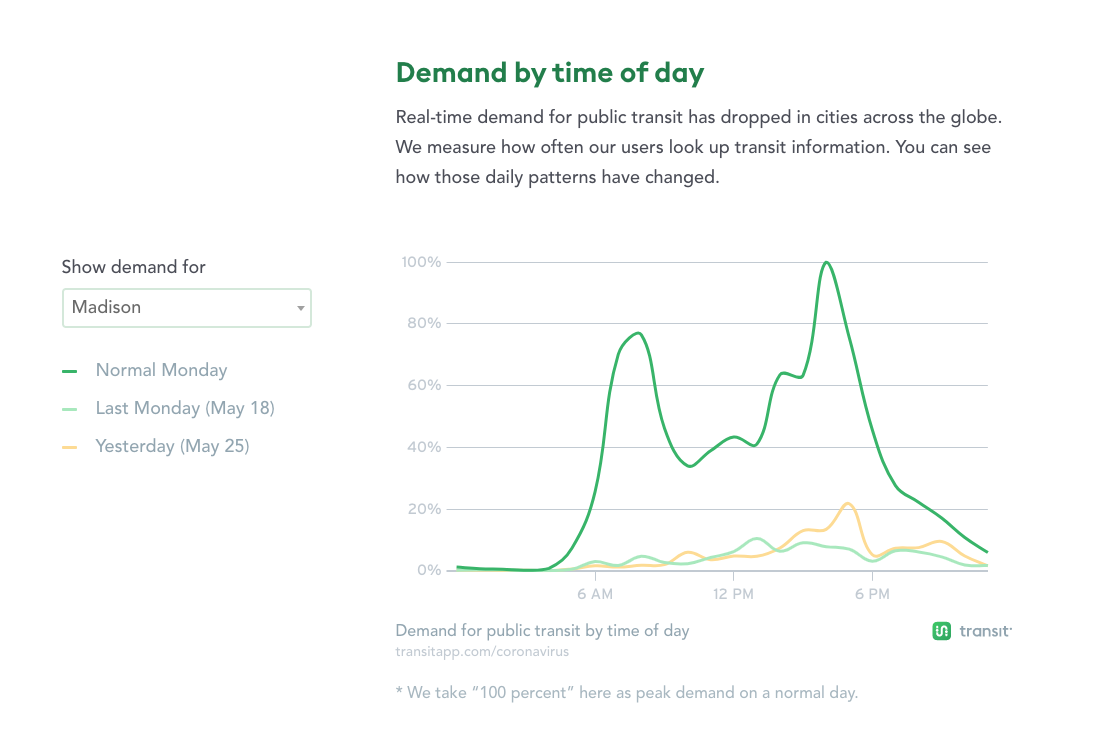
  • Service usually added for rush hour, unless it’s the only service to an area.   The “essential service” trips that are still on transit happen all over the clock with very little peaking.  The huge nine-to-five peak created by white collar workers is nearly gone, and of course the school peak — a big one in many agencies — has disappeared entirely.  Peak-only service is expensive, so it’s a logical first thing to go as long as people along those routes have a local service option to complete essential trips.

Difficult Options

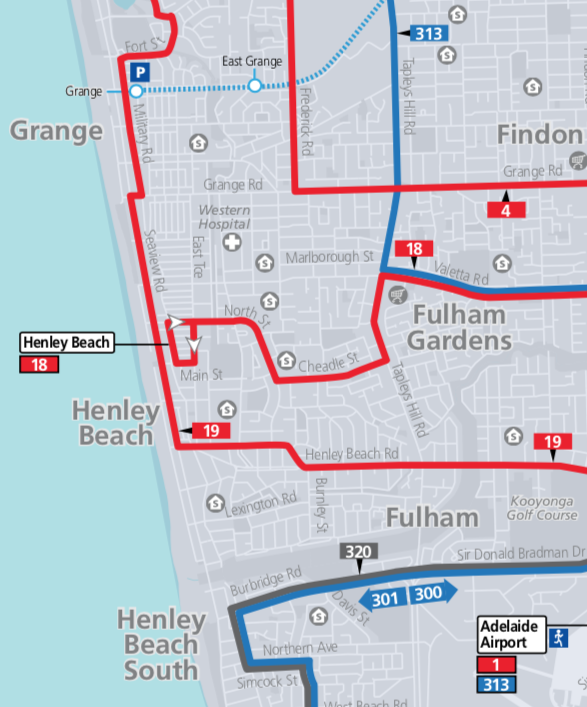
  • Cut frequencies.  Most agencies have done it. but it’s dangerous.  A common misconception is that if you cut frequency, people still have “access.”  But lower frequency means longer waits for connections, so this can cause massive increases in travel times.  A trip that takes longer than people have in their day might as well not be served at all.  A good guideline, which several agencies are following, is to cut very frequent services to run only every 15 minutes, the worst frequency at which connections are still viable, but resist cutting further.
  • Abandon service to some areas entirely, while focusing on “essential” destinations.  Many agencies have plotted the locations of essential services, especially medical centers, and retained only routes serving those.  The problem here is that the workers who need to get to those places live everywhere.  To make all essential trips possible, you need a degree of citywide access, at least to all areas where incomes match the typical pay of essential workers.
  • Cut duration of service.  This totally abandons some essential shift workers, especially in the 24/7 medical world.  Most transit agencies were already offering little or new overnight service, and closure of restaurants and entertainment has eliminated most of the ridership of evening service.  But further reductions of span can still be a problem for essential services workers, who may have to travel all over the clock.
  • Increase walking distances consistently.  In a grid network where there are routes about every half-mile or 1 km, just turn off every other route, so that walking distance to transit increases but everyone still can get to some service.  More on this interesting option below.

4.  What Agencies are Doing, and May Do

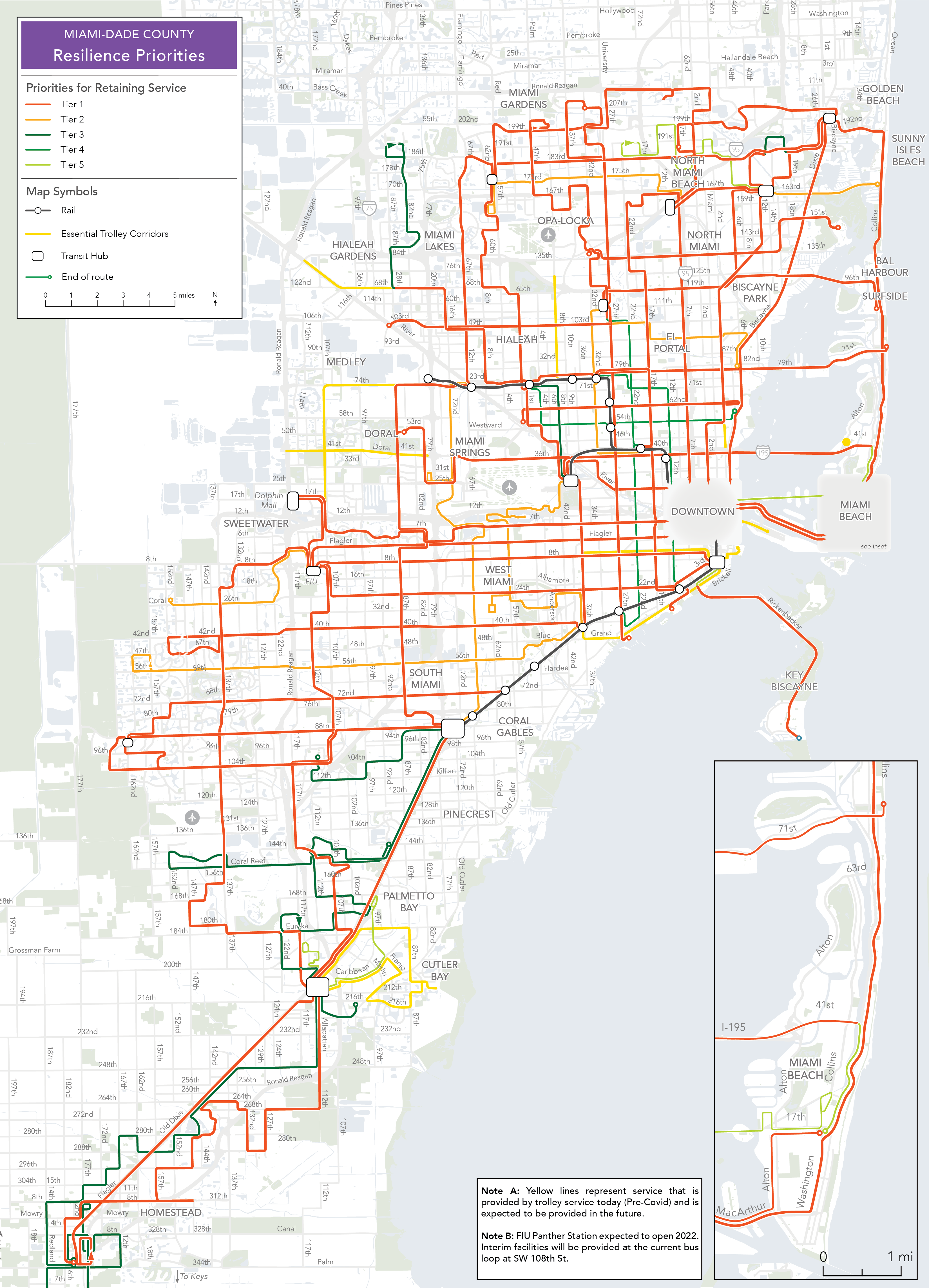
The most common quick response to the crisis has been to go to Saturday or Sunday schedules.  This effectively does a bit of everything on the “difficult options” list.  It’s totally reasonable as a quick response.  Saturday and Sunday schedules already exist, have already been approved by both union and management, and are relatively easy to turn on.  The normal process of writing, approving, and implementing a schedule takes months, with procedures that tend to be strictly defined in labor contracts.  Many agencies have found their unions to be motivated to help make things work in the crisis, but that approval process still takes time.  So it’s understandable that using weekend schedules was the thing that could be done fast.

Still, several agencies have already managed to implement more carefully designed service cuts.  Cleveland’s RTA, for example, has completed a service cut with revised schedules reflecting detailed thought about every route and how to make a minimally functional and connective system.  In their case, the suburbanization of low income means they can’t cut any coverage, but they’ve turned off their downtown shuttles and carefully chosen frequencies for each route to optimize travel times.

It’s critical that transit agencies do these designed reduced networks they have time to think about it.  Many transit agency Sunday schedules are just the daytime network run less frequently, and often don’t work very well because it can take an hour to change buses.  But transit agencies will be running on reduced demand and resources for some time, so more careful design is needed.

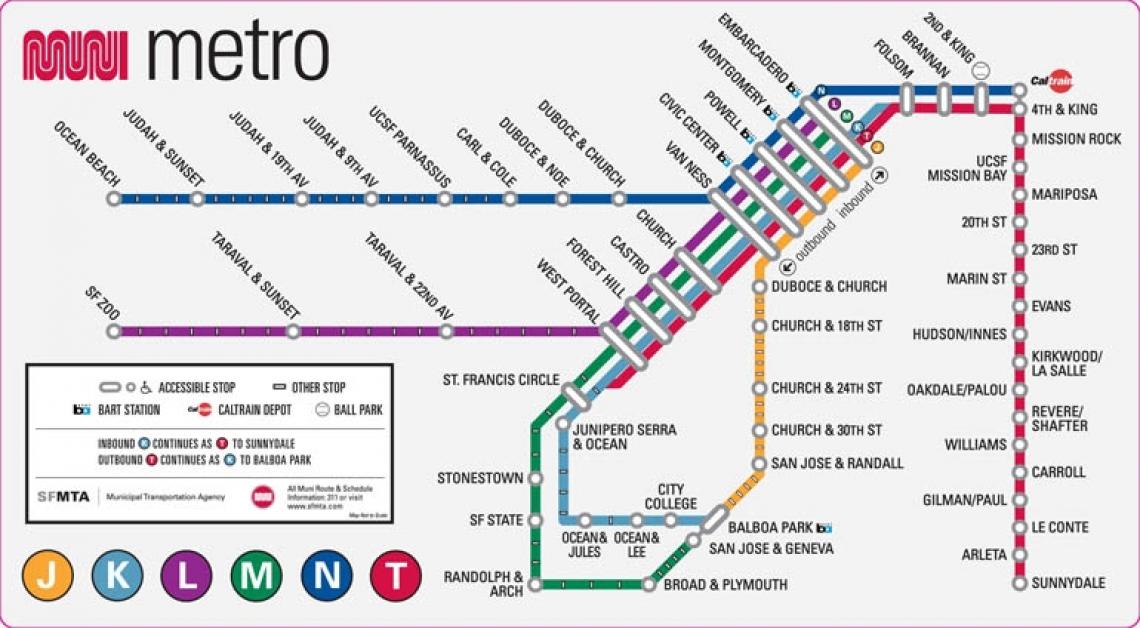
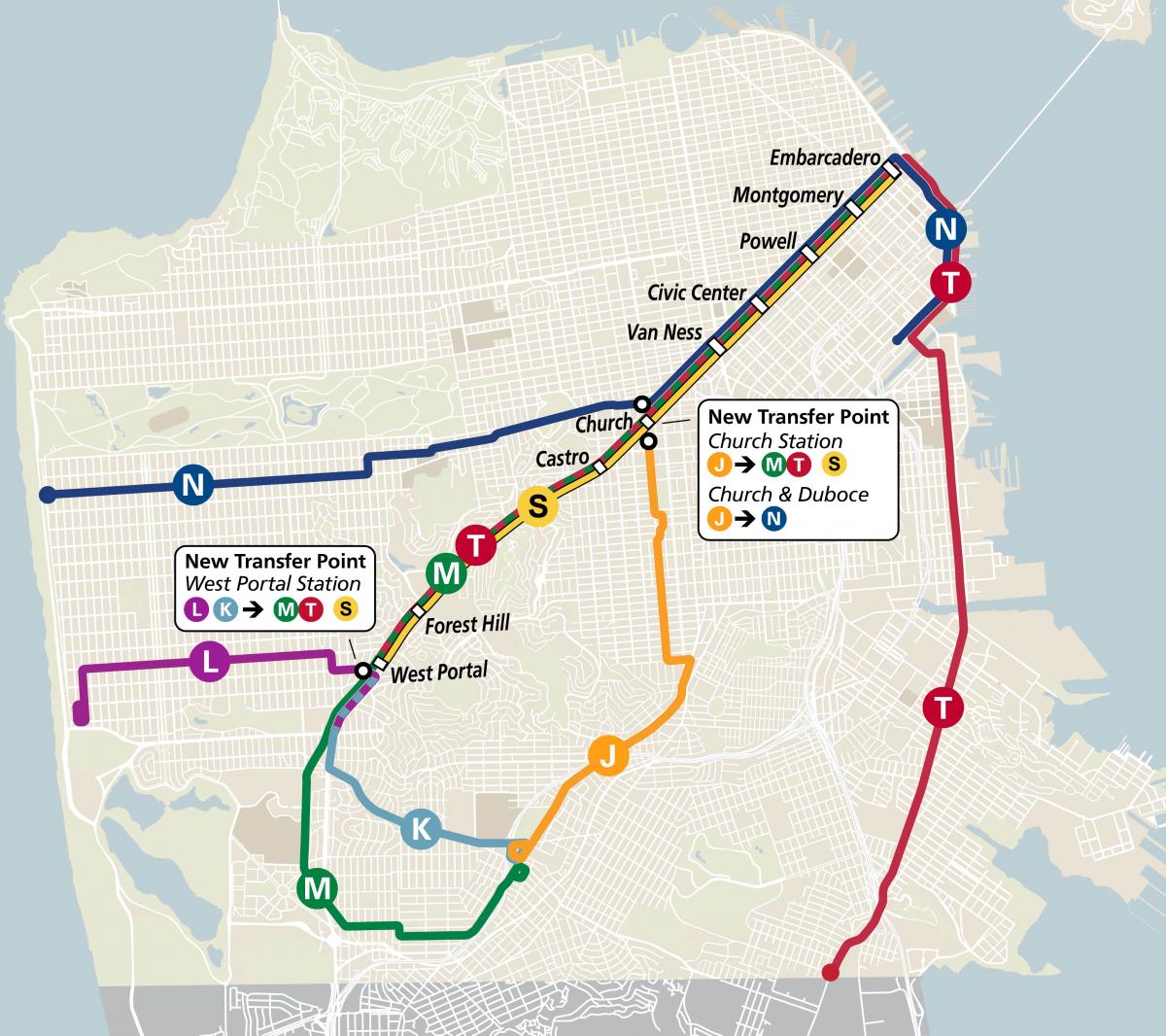
San Francisco and Philadelphia (within the city) are among the cities where the cuts have tended to protect frequency bhy increasing walking distance — though of course this works best in old cities that are relatively walkable.  San Francisco has turned off many routes and thus increased walking distances to about a mile but in return its frequencies are 20 minutes or better everywhere, so once you’ve walked to a functioning route you can be on your way.  Their new “Core” network doesn’t immediately show a consistent route spacing, because their initial design was limited to turning existing routes off or on, but if this goes on I wouldn’t be surprised if they start doing modest restructuring to improve the amount of useful service they can provide with such reduced resources.

5.  Three Stages of Adaptation and Recovery

From what agencies are doing, and the facts behind them, I think we can identify three stages that agencies are going through, or likely to go through, as they deal with the combination of (a) suddenly needing to cut service and (b) retaining the ability to slowly grow service back as demand returns, knowing that the pattern of new demand may be different from the old.

Stage 1.  Emergency cuts.  These cuts, mostly done by now, are necessarily rushed and crude, such as going to weekend schedules.

Stage 2.  Designed cuts.  When time permits, refine the schedules to better reflect actual patterns of “essential services” needs during the emergency.

Stage 3.  Strategic design.  While Stage 2 generally works with the existing network structure, this stage may revise routes or even redesign some services.  You would do this, though, only if you think that redesign will probably continue making sense as demand returns.

Everyone knows that when this crisis passes, they will emerge into a different world with different patterns of demand.  The usual controversy around network changes, where we disrupt patterns that people are used to, will no longer apply, because nobody’s used to anything at the moment, and we all know the new world will be different from the old.  We can anticipate some reasons that the return of service will need to follow new patterns:  People who can drive will be slow to return to transit, but people without a good option of driving will show up in much greater numbers.  So service priorities optimized for the latter may be the best way to bring service back, and that’s not always what existing route structures are designed to do.

In short, like all crises, this is an opportunity.  And because this is a big and enduring crisis, the opportunity is big and enduring too.


Transit Prevents the Collapse of Civilization

My piece on transit’s role in the Covid-19 crisis, and what it should teach us about what it’s role has always been, is in Citylab today.  Key idea:

The goal of transit, right now, is not competing for riders nor providing a social service.  It is helping prevent the collapse of civilization.

What’s Wrong with an Empty Bus?

Why is this bus in Paris empty? It’s parked at the end of the line.

When people want to imply that public transit is irrelevant or failing or wasteful, they always point to relatively empty buses or trains.  To the layman it certainly seems as though buses with few passengers aren’t achieving much.

This common line is based on two false assumptions.  It assumes that empty seats indicates waste, which they usually don’t, and it falsely assumes that ridership is transit’s only measure of success, which it isn’t.

The Math of Efficiency: Run the Biggest Bus You Will Ever Need

In fact, when a transit agency runs a relatively empty bus, they’re doing what they’re told to do, and they’re doing it efficiently.

Transit operating cost is mostly labor.  The cost of a bus is in the driver, not the size of the vehicle.  So it doesn’t cost much for the vehicle to be bigger than needed.

But it costs a lot for the bus to be too small.  Then you have crowding, or you leave passengers behind.

Demand for transit goes up and down during the day, and on different parts of the route.  It also goes up and down for unpredictable reasons.  A school decides to have a field trip, and a normally empty bus is suddenly packed.  Nice or bad weather can change ridership patterns suddenly.

Buses and trains cannot dynamically shrink or expand to match these changing demands, and since the operating cost lies mostly in the driver, there wouldn’t be much to gain by doing that.  For example, you might propose that after the morning rush hour the big buses should be replaced by smaller ones.  But the cost of paying a driver to take a bus back to the base and take out a different one far exceeds any cost in running a larger bus than you need for a few hours.

So transit agencies are smart to run the biggest bus they will ever need, even though that means the bus will be empty at some hours, or on some parts of the route, or even on some days when demand is lower.  They may even run a bigger bus than a route ever needs, because there are also massive inefficiencies in having too many different kinds of buses.  Smart agencies have thought this through and what they are doing, in my experience, mostly makes sense.

Ridership Is Not Transit’s Only Measure of Success

If ridership were the only goal of transit, it would look very different.  For example, it wouldn’t serve many parts of the city, because high ridership is just geometrically impossible in those places, for reasons we explain here.  For example, it would delete a service that almost nobody is using, and it wouldn’t waste five seconds on people’s complaints that they really need or deserve that service.

The people who govern transit agencies — who are either elected officials or their appointees — almost never tell their staffs to run the agency this way.  They want ridership, but they also want a lot of other things that often justify running low-ridership service.

The 2020 Covid-19 epidemic proved this point.  Instead of shutting down and laying off most staff, as a profit-making business would logically do, most big city agencies did their best to run service, not just to keep their staff employed but also to enable those “essential service” workers to get around, so that the city could keep functioning.  To do this, and to encourage social distance, they ran intentionally “empty” buses and discouraged people from riding them.  In this, transit revealed itself to be the opposite of a business.  It’s a utility, an essential element of the functioning of a city.


Watch or Listen: How Can Covid-19 Transform the Transit Conversation?

Yesterday I had a wonderful conversation with Rachel Zack of Remix about what Covid-19 means for transit.  Like all crises it’s an opportunity, and I hope you enjoy this exploration of all we can learn from it.

The conversation goes from 2:57 to 51:50.  Q&A starts at 32:07, but the questions were all excellent, so stay with it to the end.  You can treat this as a podcast, since almost all of it works as pure audio.

Covid-19: Transit Will Not Survive Without Help!

Public transit in the US is facing an unprecedented crisis.  Fare revenue will collapse as people stay home, while the tax revenues that transit relies on will also decline steeply as we go into a recession.  Some small transit agencies are shutting down, but most are trying to keep going, as a public service.  As I recommended, many are cutting peak commute service but keeping the all-day service that is a city’s lifeblood, and the lifeline of the people who are keeping things running right now.

Fortunate people use airlines, so they’re obsessed with saving them.  But if we want transit to still be there when this crisis is past, emergency assistance will be critical.  See below for what you can do.

Here’s the statement by the American Public Transit Association today:

March 17, 2020

Urge Your Members of Congress to Fight for Public Transit COVID-19 Funding!

Congress is actively working on a third package of COVID-19 response legislation and an emergency aid package could pass in the coming days.?Public transportation organizations are taking extraordinary efforts to protect the health and safety of riders and employees while working tirelessly to maintain essential services. We want to ensure that the federal government includes aid to public transportation agencies to help offset the additional costs and lost revenue related to COVID-19.?

APTA requests $12.875 billion for public transit to offset direct costs and revenue losses of COVID-19 in Fiscal Year (FY) 2020. These funds are necessary to maintain essential services, including providing public transportation to health care workers, Medicaid recipients who receive non-emergency medical transportation, and law enforcement personnel. Without these emergency funds, public transit agencies may be required to suspend services.

The APTA request of $12.875 billion will offset the following costs and losses:

  • Direct Costs: $1.75 billion. Based on preliminary results of the APTA survey, 98 percent of public transit agencies have increased direct costs because of COVID-19 (e.g., cleaning vehicles and facilities);
  • Farebox Revenue Loss: $6.0 billion. We anticipate a 75 percent loss of farebox revenue over the remaining six months of FY 2020 (total annual revenue: $16.1 billion);
  • Dedicated Sales Tax Revenue Loss: $4.875 billion. We anticipate a 75 percent loss of dedicated sales tax revenue over next six months (total annual revenue: $13 billion); and
  • Restart Costs: $250 million.
CALL TO ACTION

We strongly encourage you to contact your Members of Congress today and share the impacts, such as ridership losses and increased costs due to labor and cleaning products, of COVID-19 on public transportation in your communities.

To contact your Members of Congress, please call 202.224.3121.

Covid-19: What if Transit Runs Out of Money?

The sudden decline in travel due to fear of Covid-19 is obviously affecting public transit.  Preliminary and unpublished numbers shared with me by two US West Coast agencies showed ridership losses of 30-50% from pre-crisis levels.  We’ll see plenty of published numbers soon. The sudden fall in gas prices at the same time could make the ridership impacts even worse.

This is a good time to remind ourselves, and our favorite journalists, that ridership is always volatile and heavily driven by factors outside an agency’s control.  There are many things transit agencies can work on to improve ridership, but (a) those things together amount to a minority of the total forces governing ridership and (b) ridership isn’t the sole metric of success for transit agencies, and sometimes not even a predominant one.

However, transit agencies can do things that will cause ridership to fall further and stay down longer:  They can cut service, as they will be tempted to do now.

It’s not hard to see the dangers:

  • Declining fare revenue, due to lower ridership.
  • Declining tax revenue, due to economic slowdown.[1]

So what should transit agencies do if they start to run out of money?  Cut service?  If so, how?

First, let’s distinguish between service and capacity.  If revenue falls, many urban transit agencies can trim rush hour capacity without affecting customer mobility very much.  If you’re running a commuter bus every 7 minutes at rush hour, cut that to 10 or 12 or whatever the loads support.  Because peak commuters mostly plan around the schedule, the impact on travel time is trivial, but you’ll save something.  Peak-only service is very expensive, so you can save a lot by trimming that.  What’s more, preliminary numbers I’ve seen show commute ridership falling much more steeply than all-day local ridership, which suggests that the peak should bear the brunt of any temporary service cuts.

By contrast, when you start cutting all-day and all-week service, by reducing frequencies, you start to dramatically reduce the usefulness of network, and this is the most efficient way to drive riders away.  You also trigger social justice impacts, because lower income riders tend to be all-day, evening, and weekend riders, not just peak riders.

Remember, the riders you drive away due to service cuts will stay gone until the service improves again, while those who are just working from home will come back post-crisis if the service is still there.  

Second, if money runs low, you have to question the schedules of your infrastructure projects.

Infrastructure projects are so complicated and involve so many possible points of failure that they require a concerted effort to maintain momentum. All the messaging around how inevitable the project is, and how certain the opening day is, can make it sound like nothing can be slowed down in response to a crisis.  Of course, some contracts do impose costs for slowing and stopping, and those have to be considered.

But if infrastructure work continues while service is being cut, you’re driving away current riders for the sake of future riders, and if the goal is ridership, that makes no sense.  It can also be a social justice problem.

Why do I have to point these things out?  Influential people often tend to be peak commuters, so they defend peak service but care less about all-day service.  They also tend to be invested in infrastructure, and don’t want to hear that those projects might have to slow down.  To many of them, all-day service can seems easy to cut by comparison, since that affects people who don’t comment as much.  But apart from trimming peak capacity, that’s the sure way to turn a temporary crisis into a more lasting one.


[1] These impacts will be cushioned if agencies have (a) a lot of pre-sold fares, such as employer programs and (b) tax sources that rely on less-volatile sources like property or income tax, as opposed to payroll or sales taxes.


Working on Climate Change? I Have a Question

Like many people, I’m terrified of climate change and see it as an important reason for my work.  But when I listen to climate activists, or the politicians they have trained, I’m puzzled by a word that they use.  It’s planet.  We have to “save the planet,” they say.

On the surface, there are two obvious problems with this word choice, so there must be some more subtle reason for using it, one that I need to be enlightened on.

First, the everyday meaning of planet, the one we learned in high school, is something like “a sufficiently large ball of matter orbiting a star.” If that’s what a planet is, then climate change doesn’t threaten the planet. Earth as a ball of rock will be fine.

So when we say “save the planet” we’re using planet in a newer and different way to mean something like biosphere — the sum of all life.  Actually, the meaning seems purposely fuzzy: do we think climate change will destroy all life on earth, or just destroy lots of species, or destroy our civilization, or destroy us?

In my work as an explainer, I try not to coin new words, or create new meanings of words, if there’s any way I can avoid it.  There’s an unavoidable rush of power when you create a word or meaning.  However worthy the reason for your coinage is, it sounds like you’re telling people that they’ve been talking wrong all their lives and only you are talking right. Because the way we talk is semi-conscious and hard to change, people can feel that attack subconsciously, not even articulating why it bothers them.  But like many subconscious responses it can make them defensive, which keeps them from getting to where we need them to be.

Second, many people who don’t care much about the “planet” care very much about civilization, including mainstream conservatives.  Apart from some survivalists and those awaiting an imminent Rapture, conservatives want to conserve their society — to keep it from changing too rapidly.  If we wanted them to hear us, it seems to me, we’d speak of climate change as a threat to civilization.

Speaking that way, we’d also be talking about something that we can be pretty sure about. Nobody can predict the biological consequences of climate change, but we know what happens when the support systems of civilization collapse, because it’s happened many times in history: Starvation, mass migration, wars (and personal violence) over declining resources.  Far more people would be horrified by this prospect than are horrified by threats to polar bears — however much the latter, and biodiversity in general, may matter to you and me.

Climate change has a moral dimension, regarding whether we have the right to destroy other life, but the most acute climate anxiety is about fears for ourselves and our children, not fears for the “planet.”  It’s about looking at your children and wondering if they’ll starve, or kill and die in wars, or live in patriarchal bands where rape is routine — all things humans have done repeatedly under similar pressures.  We have a robust genre of apocalyptic literature increasingly focused on imagining a world in which civilization has collapsed. If you wanted to alarm conservatives into action, it seems to me that you’d talk about this.

So why do I so rarely hear advocates or politicians say that climate change threatens civilization? Why do we keep using the word planet?  Please enlighten me.

Are Uber and Lyft Increasing Traffic Deaths?

[Update:  Joe Cortright of City Observatory has published a critique of this study]

When Uber or Lyft starts serving a city, more people die in crashes.  This is the horrifying finding of a new National Bureau of Economic Research (NBUR) paper by John M. Barrios, Yael Hochberg, and Hanyi Yi.  From the abstract:

We examine the effect of the introduction of ridehailing in U.S. cities on fatal traffic accidents. The arrival of ridehailing is associated with an increase of approximately 3% in the number of fatalities and fatal accidents, for both vehicle occupants and pedestrians. The effects persist when controlling for proxies for smartphone adoption patterns. … These effects are higher in cities with prior higher use of public transportation and carpools, consistent with a substitution effect, and in larger cities. These effects persist over time. Back-of-the-envelope estimates of the annual cost in human lives range from $5.33B to $13.24B.

This chart says it all:

Figure 2. Barrios et al, “The Cost of Convenience: Ridehailing and Traffic Fatalities”  NBER 2020.


For each of the studied cities, the vertical red line represents the arrival of Uber or Lyft (whichever arrived first) and the dots are the traffic accident rates.  The rate not only starts going up after Uber or Lyft arrive.  It is still going up two years later.  The paper goes into great detail, separating out possible related causes such as increasing cellphone use by motorists.  The correlation is pretty strong.  It is true of both the number of crashes and the number of people who die.

The authors find other evidence that isolates Uber and Lyft as the cause.  In particular:

… the effect is concentrated in [ridehail]-eligible vehicles (relatively new, four-door vehicles) and is not present for accidents involving [ridehail]-ineligible vehicles (two-door vehicles).  [p5]

One common selling point for Uber and Lyft is that they reduce drunk driving, but on balance, no:

We find that accidents and fatalities related to drunk driving do not decrease [after the arrival of Uber or Lyft]: if anything, we find evidence of a small increase … [p5]

I hope this all isn’t true, but if it is, it matters.

A few factors probably at work here.

Shifting trips from public transit to Uber or Lyft — which is definitely happening in major cities — means more than just increasing traffic.  It means shifting people from a very safe mode of transport to one that is more dangerous, to the customer and to others on the street.

It’s not just that big transit vehicles are more crashworthy.  Your bus driver has been selected and trained for safety, and is probably randomly tested for drug and alcohol use.  Bus drivers also have training in anger management, so they know how to control the strong emotions that come up as things happen in traffic.

Uber and Lyft promise you none of these things.  Drivers must have a clean driving record and criminal record, but beyond that the only promise of safety (for yourself and others) is that dangerous drivers get low ratings.  What’s more, customers demand contrary things with their ratings.  I give a low rating for driving over the speed limit in cities, because I value human life, but others might give a low rating for driving so slowly.

What I find, as a frequent user of both transit and Lyft, is that the safety of Lyft drivers is very diverse, and that the bad ones are very bad.  Safety also varies dramatically by region.  At home in Portland I rarely get a driver whose phone isn’t mounted on the dashboard, but when I use Lyft in Texas and Florida, most drivers have the phone in their laps, and drive along looking down.

Uber and Lyft are very useful, but we are learning more and more about their negative impacts: higher traffic, weakening support for essential public transit, and now, well, more people dying.  Where does this end?


Miami-Dade: A Draft New Network

Esta página está disponible en español aquí.


For the last year we’ve been working on a bus network redesign project in Miami-Dade County, Florida, partnering with the local advocacy group Transit Alliance on their Better Bus Project.  In this unusual arrangement, Transit Alliance is paying for much of the work out of funds that they have raised, though of course Miami-Dade Transit is an active partner in working to develop a plan they can implement.

A draft of the New Network is now out and ready for community input, and you can read the full report here. This New Network is based on the public input received on the Concepts released last fall and it reflects a shift in the balance of ridership and coverage goals toward higher ridership based on the public response to those concepts. This New Network has been created in partnership with Transit Alliance, County, and municipal staff, and in particular City of Miami and Miami Beach staff who have helped guide the redesign of municipal trolleys.

The local newspaper, the Miami Herald, has a good article about the Draft Network and the major improvements it provides to most people in Miami-Dade. If you live in Miami-Dade you should study this New Network and take the survey before March 31st.

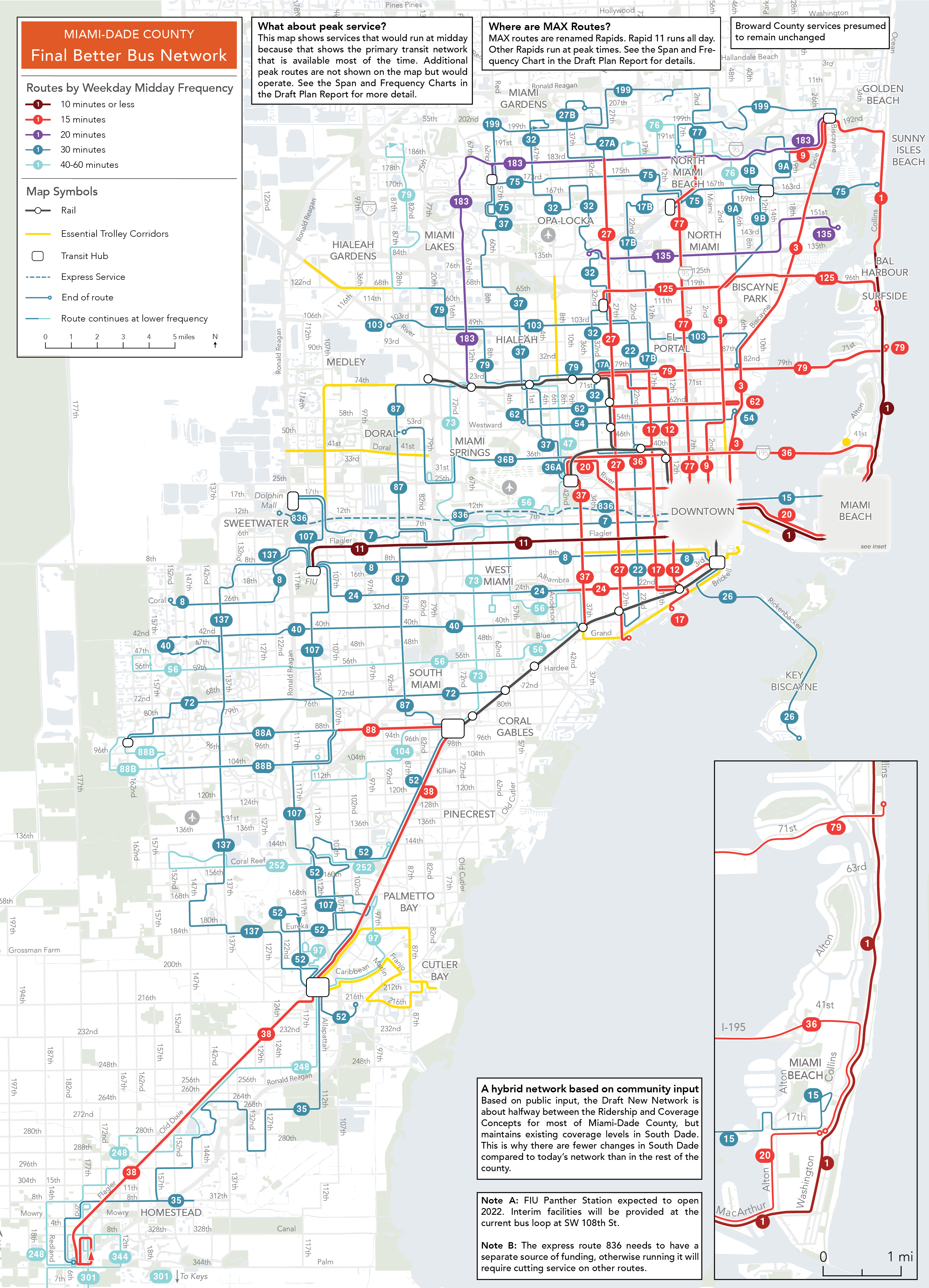
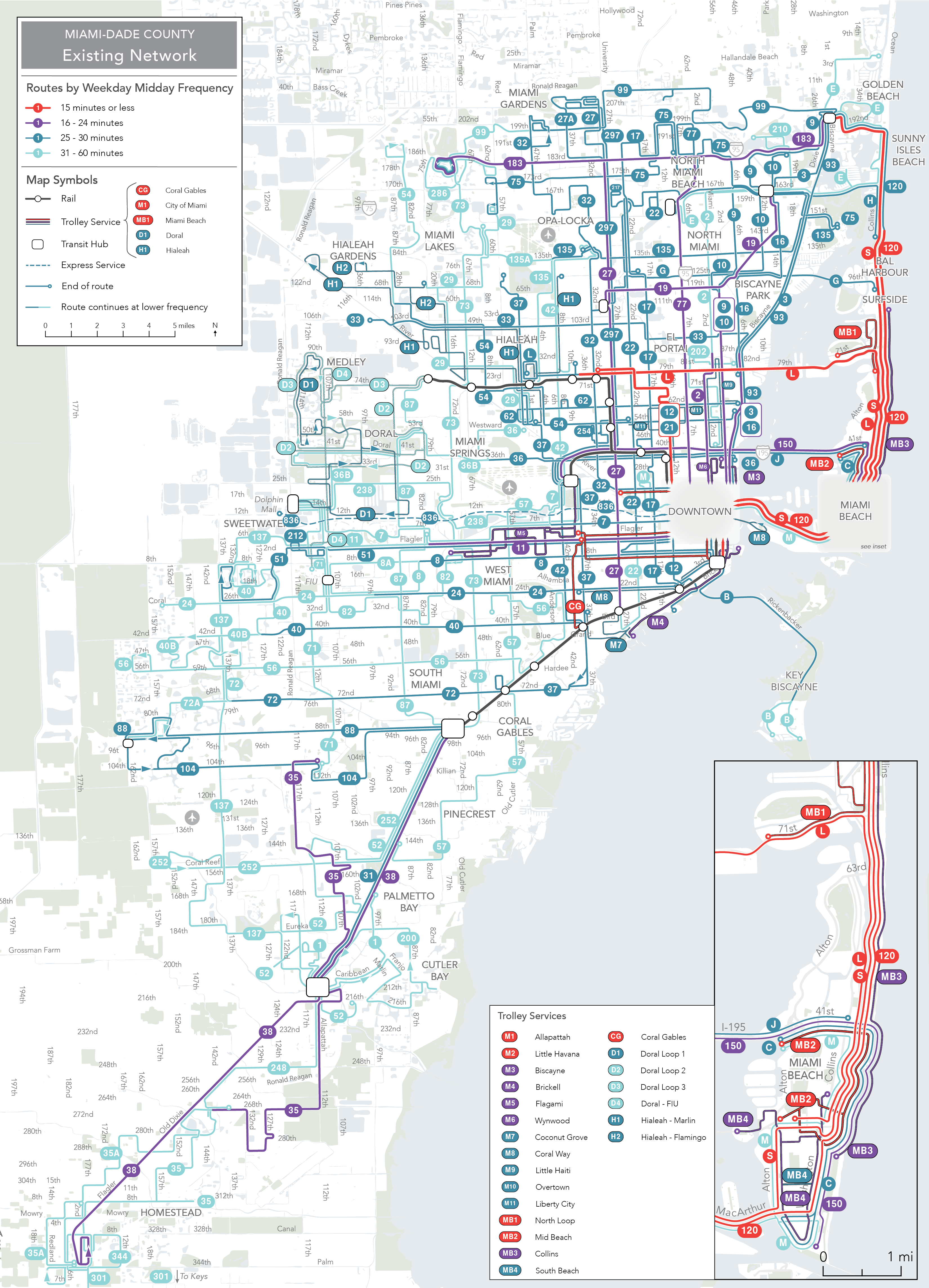
We previously released a Choices Report that highlighted one of the major shortcomings of the existing network, a lack of a frequent grid. The New Network builds more of a frequent grid, at least in the core of the network, through consolidation of closely spaced routes, trading roles between the County and municipal trolleys, especially in the City of Miami, and some reductions in coverage, particularly in municipalities that provide trolley service.

Below are slices of the Existing Network and New Network for the core of the region (click the maps to see the full size maps of both networks).

Existing Network

New Network

The result of this frequent grid is that 368,000 more residents are near a frequent route, which brings the total population near frequent service to 25%. In the Existing Network only 11% of residents are near a frequent route.

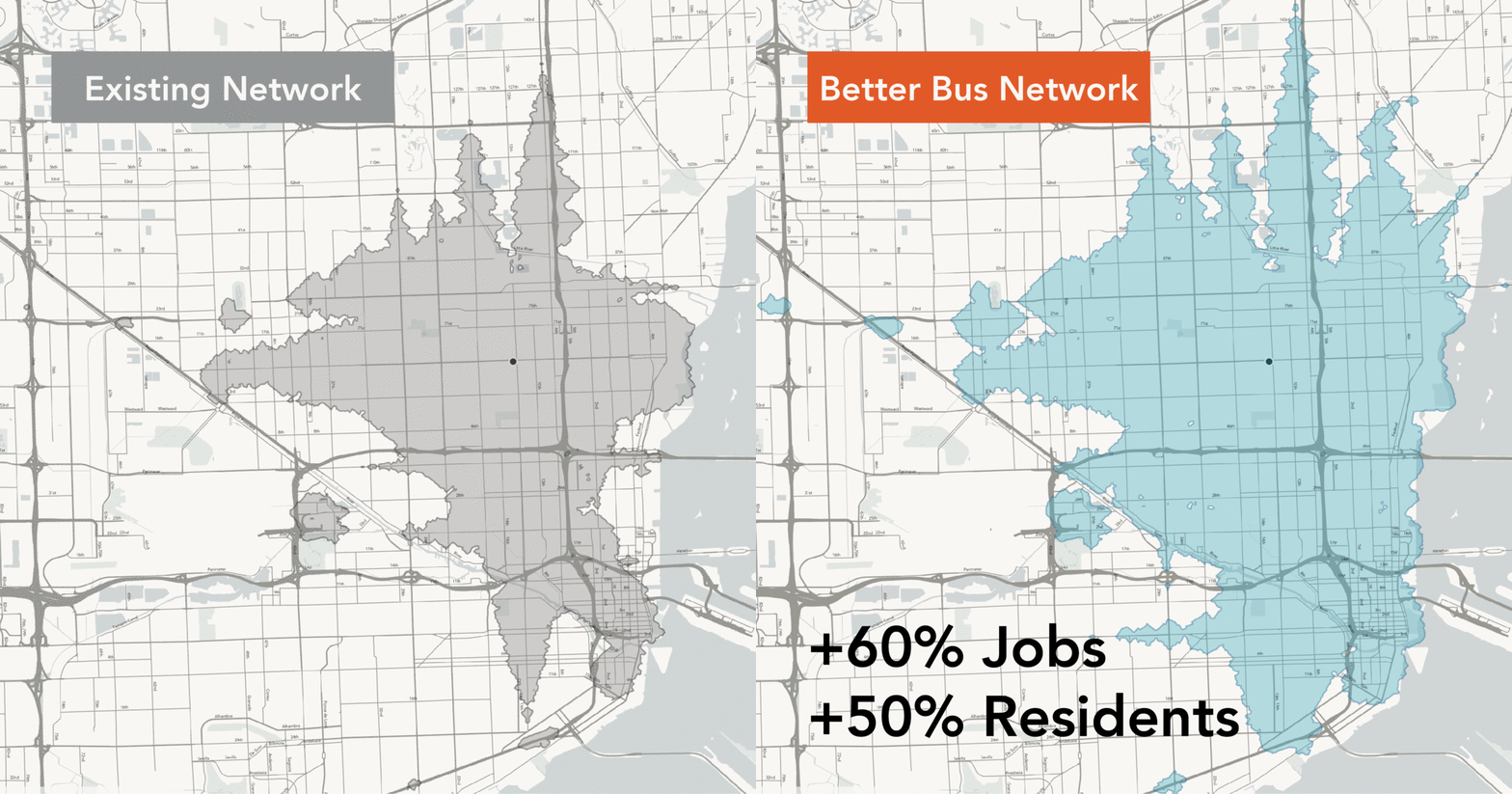
The power of the frequent grid means that there is a vast expansion in where people can go in a reasonable amount of time. Below is a comparison of where someone who is starting in Liberty City (NW 12th Avenue and 62nd Street) can reach in 45 minutes by walking and transit. The gray area is what is reachable today under the Existing Network. The light blue area is the area reachable with the New Network. The frequent grid in the New Network vastly expands your freedom if you live here and means you could reach 60% more jobs and 55% more people.

We can assess this change for all people and places across the county and doing so gives us the map below, showing in blue the areas where people can reach more jobs and in red the areas where people can reach fewer jobs with the New Network. Each dot in this map represents 100 people.

The map shows that the vast majority of people and places see a large increase in job access. Averaged across the entire county, the typical county resident would be able to reach 33% more jobs in an hour with this New Network.

Now these improvements are part of some painful compromises. This network emphasizes Ridership goals more than the Existing Network. Thus, some low productivity routes serving Coverage goals are cut so that more frequency can be provided in dense, walkable, linear places. Overall, about 3% more residents would be more than ½ mile from service with the New Network.

The New Network costs the same as the Existing Network and is fully implementable within six to nine months, but this network isn’t going to be implemented until the public, stakeholders, riders, and others have a chance to consider this change and respond. So, read up and tell Transit Alliance and the County what you think.

If you agree this New Network would be an improvement for Miami-Dade, it’s important to speak up because many people who will benefit from this New Network won’t be paying attention and won’t speak up. And if you don’t like the plan, please let Transit Alliance and MDT know how it can be improved. But remember, any change must be made in a cost neutral way, so an increase in service in one place means we have to cut service somewhere else.  We always get great ideas out of public comments at this point.

It’s also important to think beyond current and potential transit riders to all the other interests that will benefit.  A vast expansion in where people can get to means better access to jobs, services and shopping across the county.  Businesses can see how the plan improves access for their employees and customers.  Finally, everyone who cares about transit outcomes – economic, environmental, or social – should care about what this plan could achieve.

Finally, as consultant, we don’t claim that this is all the service that the county needs; it’s just what the county and cities can currently afford. There are obvious places were additional investment in service would greatly improve access for thousands of people. Some ideas for improvement are documented in the Report on the New Network, such as increasing the frequency of service on the 20-minute routes in the New Network (Routes 9, 62, 88). Also, on Sundays most of the frequent network becomes every 20 minutes. In a region with such a large tourist economy, Sunday service should be closer to weekday and Saturday levels.

Miami-Dade: Una Nueva Red de Transporte Público, Plan Borrador

This page is available in English here.


Durante el último año hemos estado trabajando en el proyecto Better Bus para rediseñar el sistema de autobuses en el Condado de Miami-Dade, Florida, en colaboración con el grupo de interés local Transit Alliance. Este es un caso inusual ya que Transit Alliance está usando fondos recaudados para pagar por gran parte del proyecto, aunque Miami-Dade Transit ha sido un miembro activo del equipo desarrollando un plan que ellos pueden implementar.

El plan borrador de la Nueva Red ya se publicó y está listo para recibir comentarios del público. Puedes leer el informe completo aquí.  Esta Nueva Red se diseñó considerando los comentarios que recibimos del público en la fase de los Conceptos el otoño pasado. Siguiendo los resultados encontrados en este proceso de participación ciudadana, la Nueva Red refleja un cambio en el balance entre más frecuencia y cobertura, resultando en más servicio de alta frecuencia (que aumentaría el número de usuarios). Esta Nueva Red se creó en conjunto con Transit Alliance, el Condado, empleados municipales, y en particular empleados de las Ciudades de Miami y Miami Beach, quienes han ayudado a guiar el rediseño de los trolleys municipales.

El periódico local, el Miami Herald, publicó un buen artículo sobre la Nueva Red y las mejoras principales que afectan positivamente a la mayoría de la comunidad de Miami-Dade. Si vives en Miami-Dade, deberías revisar la Nueva Red y tomar la encuesta antes del 31 de marzo.

Previamente, publicamos un Informe de Opciones que destacaba una de las mayores deficiencias del sistema actual, la falta de una red frecuente. La Nueva Red crea una red más frecuente en las partes más densas del sistema a través de la consolidación de rutas muy cercanas unas de las otras, cambiando la función entre algunas rutas del condado y los trolleys (especialmente en la Ciudad de Miami) y algunas reducciones en cobertura, particularmente en municipios que ya tienen servicio de trolley.

A continuación podrás ver unas secciones de la Red Existente y la Nueva Red en el centro de la región (haz clic para ver los mapas completos de ambas redes).

la Red Existente

la Nuvea Red

En esta nueva red, 368,000 residentes más están cerca de una ruta frecuente, lo cual hace que el número total de personas cerca de servicio frecuente suba a 25%. En la Red Existente, solo 11% de los residentes viven cerca de una ruta frecuente.

El poder de la red frecuente significa que hay una expansión significativa en los lugares a donde la gente puede ir dentro de un tiempo razonable. A continuación, hay una animación que compara los lugares a donde una persona en Liberty City (NW 12th Avenue and 62nd Street) puede llegar en 45 minutos en transporte público y caminando. La zona gris muestra a donde una persona puede ir hoy, con al Red Existente. La zona azul claro muestra a donde una persona puede ir con la Nueva Red. La red frecuente en la Nueva Red provee una expansión muy grande a tu libertad si vives aquí. Podrías acceder a 60% más oportunidades (trabajos y servicios) y 55% más personas.

Podemos evaluar este cambio para todas las personas y todos los lugares del condado. El resultado se muestra en el próximo mapa. Las zonas azules muestran en donde la gente puede acceder a más trabajos y las zonas rojas en donde la gente puede acceder a menos trabajos con la Nueva Red. Cada punto en este mapa representa 100 personas.

El mapa muestra que la gran mayoría de la gente y los lugares ven un grande aumento en el número de trabajos accesibles. El promedio a lo largo de todo el condado muestra que el residente típico del condado puede acceder a 33% más trabajos en una hora de viaje con esta Nueva Red.

Estas mejoras son parte de compromisos dolorosos. Esta red enfatiza más las metas de alta frecuencia que la Red Existente. Por lo tanto, algunas rutas de baja productividad con metas de proveer cobertura se han eliminado para poder proveer más servicio en lugares que son más densos, caminables, y lineares. Aproximadamente 3% más de los residentes estarán a más de ½ milla de servicio con la Nueva Red.

La Nueva Red cuesta lo mismo que la Red Existente y es completamente implementable dentro de seis a nueve meses, pero esta red no se implementará antes de que el público, las partes interesadas, los usuarios, y otros interesados, tengan la oportunidad de revisar estos cambios y comentar. Por lo tanto, lee y dile a Transit Alliance lo que piensas.

Si estás de acuerdo que esta Nueva Red será una beneficiosa para Miami-Dade, es importante que lo digas porque mucha gente que se beneficiará con este plan no estará prestando atención y no lo dirá. Si no te gusta este plan, por favor déjale saber a Transit Alliance y a MDT como se puede mejorar. Pero recuerda, cualquier cambio se debe hacer manteniendo un presupuesto neutro. Por lo tanto, aumentar el servicio en un lugar significa que hay que quitar servicio en otro lugar. Siempre recibimos buenísimas ideas de los comentarios públicos en esta fase.

También es importante pensar más allá de los usuarios actuales y pensar en todos los otros intereses que se beneficiarán. Una expansión grande en el acceso a empleo, servicios, y comercio en el condado. Empresas pueden ver como el plan mejora el acceso a sus empleados y clientes. Finalmente, a todo el mundo que le importan los beneficios del transporte público – económicos, ambietales, o sociales – le debe importar lo que este plan puede lograr.

Finalmente, como consultores, nosotros no decimos que este es todo el servicio que el condado necesita; esto es solamente lo que el condado y las ciudades pueden pagar ahora. Claramente hay lugares donde inversión adicional en el servicio podría mejorar el acceso a miles de personas. Algunas ideas de donde se puede mejorar el servicio están documentadas en el Informe de la Nueva Red, como aumentar la frecuencia de servicio en las rutas de 20 minutos en al Nueva Red (Rutas 9, 62, 88). También, la mayoría de la red frecuente se reduce a 20 minutos los domingos. En una región con tanta actividad turística, el servicio de los domingos debe ser más como el servicio de durante la semana y los sábados.