Archive | 2010

Seattle Suburbs: The Silence of Sundays

Community Transit, which serves most of the northern suburbs of Seattle, is shutting down completely on Sundays.  This wouldn’t be unusual in a small-city transit system, but CT’s service area (most of Snohomish County) is a big suburban expanse with about half a million people.  It has enough transit demand to support a low-end Bus Rapid Transit line, called Swift, which will presumably not run on Sundays either.

This is a fairly dramatic step by North American standards.  Local transit in suburban areas generally appeals to people with few choices, but many, many of these people work in low-wage jobs in the service sector, such as restaurants and big-box retail.  These business are open seven days a week and often are busiest on weekends, so most of their employees have to work some weekend shifts.  A transit system that doesn’t run on Sundays will no longer be useful to these people.  Based on what I’ve seen elsewhere, most of them will find other arrangements; CT is likely to lose them on all five days a week that they travel, not just Sunday.  Some, those without any good transport options, may lose their jobs.

I hope CT or some other local government researches what happens to these riders when Sunday service ends.  The best approach might be to survey the Sunday riders before the service stops, asking them for follow-up contacts so that they can be interviewed again a few months in the future.  This would not only provide good data for other agencies facing the need to cut service, but would also be a nice way for the agency to convey some concern for the well-being of these customers.

Children on Transit: A Personal Note

Kids_on___bwayA few days back, frequent commenter Engineer Scotty did a much discussed guest post on the problems of travelling with small children on transit.  He suggested, I thought, a reasonable range of accommodations that transit agencies should make (many of them good things to do anyway) and also talked through some things the parent can do to make the situation easier.

Scotty has twins, so he often drives a double-wide stroller/pram.  To people who don’t like the company of small children, a double-wide pram seems to evoke the same emotions that a Hummer evokes in car-haters like myself.  It seems huge, excessive, “in your face.”  As Scotty observes, it can get on a bus in pretty much the way a wheelchair does, but like a wheelchair it takes a lot of space and demands some accommodation from other passengers if the bus is crowded.

It’s been interesting to watch this post’s reception for several reasons.  First of all, a lot of this blog is about explaining concepts that not everyone has thought about, and on which many don’t have a strongly-held view.   But when the subject is children on transit, everyone’s interested and everyone has an opinion.  Scotty’s post was featured by Streetsblog, and it drove my traffic to a level not seen since Portland shock-blogger Jack Bogdanski attacked me for suggesting he pay the real price of parking in downtown Portland.   Continue Reading →

Sydney: Grid Networks for Gridless Cities

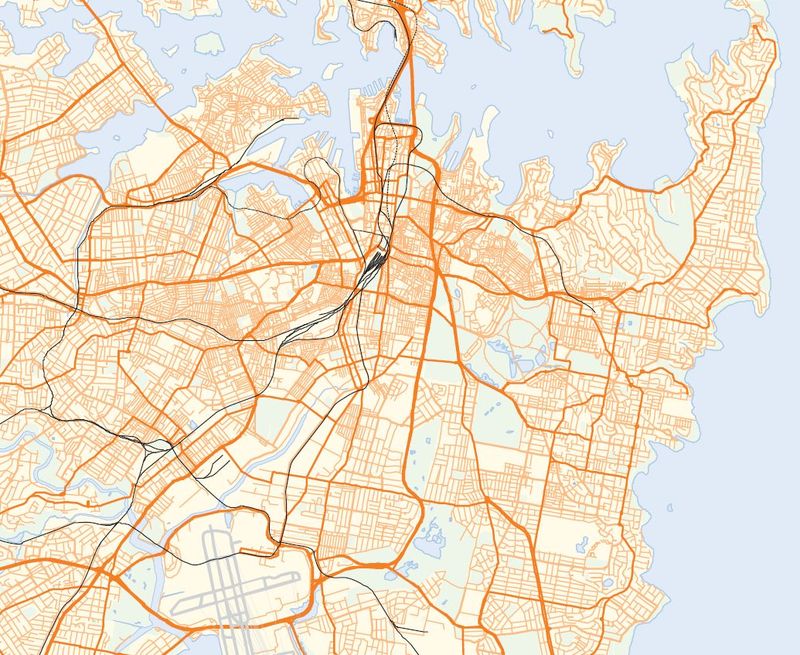
Whenever I talk about the value of grid networks, as I did here, someone always says: But my city isn’t a grid.  For example, Sydney, where I live now, is about as ungridlike a city as you’ll encounter.  In fact, there’s no large system of order in Sydney’s road network at all.  Some roads follow what were once Aboriginal tracks, but mostly it just grew, one bit at a time, an accretion of millions of short-term decisions.
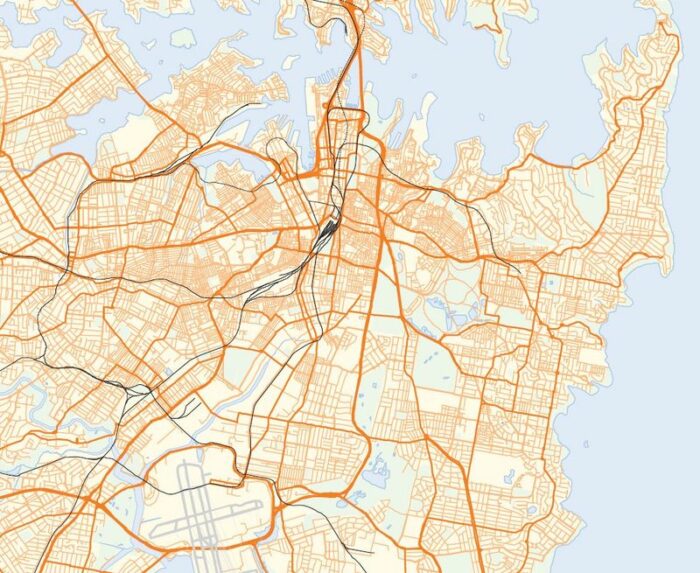
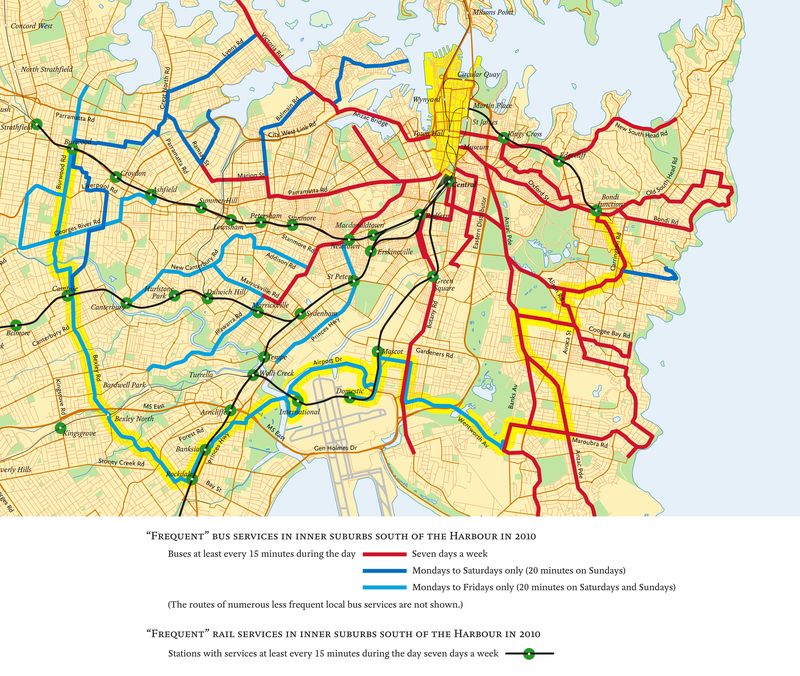
One of Sydney’s biggest problems is that the road network is so focused on the CBD (the Central Business District located top-centre in this image) that traffic is forced into the CBD that doesn’t want to be there.  But the problem is much, much worse if you’re a transit passenger.  As part of the Sydney Morning Herald‘s Independent Public Inquiry, discussed here, I did a quick review of the inner-city bus network looking for the pattern of frequent service — service that runs every 15 minutes or better all day.  The frequent network is the portion of the network where you don’t have to worry about a timetable, and where transit can therefore be used with some sense of spontaneity and freedom.  To my knowledge, nobody had drawn a map of inner Sydney’s frequent network before.  It turned out to look like this:
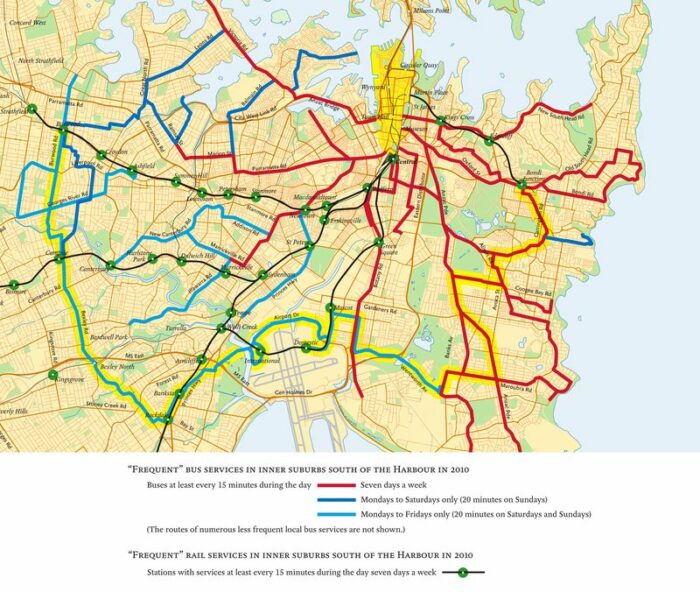
 

If you want to get around with any spontaneity in the inner part of Sydney — where densities are highest, obstacles to driving are greatest, and car-free lifestyles should be most attractive — the network forces you to go through the CBD (the yellow wedge on the north edge of the drawing). In the whole inner city of Sydney there is only one frequent crosstown or orbital service — one that runs perpendicular to the radial lines, like the circular element of a spider web.  It’s highlighted in yellow.  By contrast, most major North American and European cities have a whole grid of these orbital services; they are often the most productive routes in the network, in terms of ridership per unit of operating cost.

As part of the inquiry, I sketched a map to give just a taste of what an inner city frequent grid network might look like for Sydney.  It’s not a proposal, just a possible starting point for thinking about one.  But if you can’t imagine doing a grid network in a gridless city, you might find it interesting to stare at for a bit.  (All this is in the Preliminary Report of the Inquiry, in Section 4.2, and readers interested in the local detail are encouraged to dig there.)
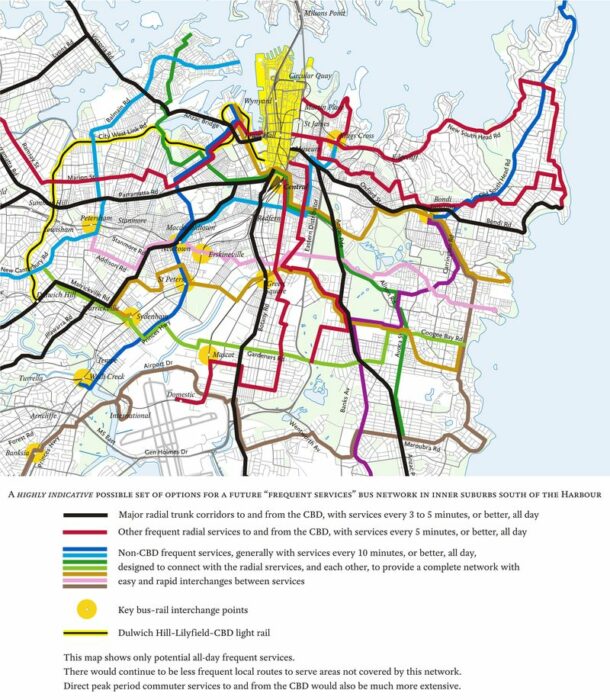
 

Sydney’s road network is so radial, and the CBD is such a large destination, that the grid takes more of a spider-web form (as defined here).  I highlighted this in the diagram by using black and red for radial lines and all the other colours for orbitals, so that people could see how orbital services might work and how they could all fit together, with each other and with commuter rail and light rail, to form a complete inner city network.

But in the middle part of the map you’ll notice some lines that do try to run straight east-west, even though the lacerated street network requires you to make many turns to keep going the same direction.  As I explored in more detail here, most grid networks involve a fusion of standard rectangular grid lines and spider-web (or polar grid) lines.  The rectangular lines express a “serve everywhere” impulse, while the spider-web lines express a “focus on the centre” impulse.  Network design is a process of finding the balance and making them work together.

There are many ways to design such a pattern for Sydney.  A detailed planning effort would feature months of work exploring various options, but what I sketched here, based on three years’ observation of the inner city and about three hours of focused thought, is at least a step toward visualizing the future.

So yes, your city may not be a grid.  But still, if you want a transit network that’s useful for going at high frequencies from anywhere to anywhere, the answer will be some kind of grid, built on connections, with some mix of rectangular and spider-web elements, all fitted with more or less struggle to the unique shape of your city.
Guest Post: Families and Children on Transit

This guest post is by EngineerScotty, a software engineer and part-time transportation geek from the Portland, Oregon areaHe is a frequent commenter here on Human Transit.

Kids_on___bwayI’m a father of several small children, including twin boys (now four years old).  [Not those in the picture — JW]   Using public transit provides parents with several challenges not faced by childless passengers; and conversely, families with children provide transit authorities with challenges–and opportunities–that are unique.  In a recent thread on PortlandTransport.com, one poster, a dedicated urbanist with a bit of a temper, made it clear to myself and other parents that he considered kids–our “screaming brats” as he put it–unwelcome on transit.  Continue Reading →

Vancouver: Olympic Transit Payoffs

DSCN0510Why should a growing city with high ambitions for sustainability host a big blockbuster like the Olympics, with all the risk and nuisance that it entails?

So that everyone can see exceptional transit ridership, and exceptional volumes of pedestrians, and exceptional limitations on private car traffic, and can ask: “What if that were normal?”

Continue Reading →

vancouver: the great broadway debate

The big rail transit debate in Vancouver at the moment concerns Broadway.  You might call it Vancouver’s Wilshire Boulevard: not always a beautiful street but a very important one.  It’s the direct line east from the University of British Columbia at the west end of the city, and goes through a major office core, including Vancouver City Hall, just south of downtown proper.  It’s the busiest east-west arterial in the entire city and the site of one of the busiest bus lines in North America, the 99.  It has everything you need for successful rail transit, except consensus.  Here again is the City of Vancouver’s transit network, with the Broadway corridor in dark orange.

VancouverGrid(2) Continue Reading →

vancouver: the almost perfect grid

In the last post, which explains why grids are such an efficient structure for transit, I mentioned that Vancouver has one of the best transit geographies I’ve ever encountered. Here’s what I mean.

Vancouver Transit

A grid pattern of arterial streets covers almost all of Vancouver. Most of the time, parallel major streets are spaced about every 800-1000m apart, and since a comfortable walking distance is about half that, this spacing is perfect for efficient transit. Continue Reading →

The Power and Pleasure of Grids

Why do transit planners love grids?  Now and then you’ll even hear one muttering about “grid integrity” or “completing the grid.”  What are they talking about?

Suppose you’re designing an ideal transit system for a fairly dense city where there are many activity centers, not just one big downtown.  In fact, you don’t want to give preferential treatment to any point in the city.  Instead, you want people to be able to travel from literally anywhere to anywhere else by a reasonably direct path, at a high frequency.  Everybody would really like a frequent service from their home to everywhere they ever go, which is pretty much what a private car is.  But money isn’t infinite, so the system has to deliver its outcome efficiently, with the minimum possible cost per rider. What would such a system look like? Continue Reading →

Vancouver: The Olympics on Transit, Week 1 in Review

I told you I thought Vancouver would be lucky.  From Vancouver reader Meredith Botta:

We have had spectacular weather over the past few days, cold enough at night to preserve the snow (and to make new snow) at the outdoor Olympic venues, and warm, sunny and clear in the day.

Trust me, you have to have lived through a Vancouver winter to understand how miraculous this is.   Gordon Price even caught some cherries blooming, a good month ahead of schedule.  Meredith goes on:

Crowdsonrobson The feeling downtown amongst the crowds is unbelievable …. lots of smiles punctuating the rainbow of nationalities everywhere.  I even bumped into a quartet of singing Russian women in a crowded Canada Line train the other day.  TransLink announced today that they hit a new record with 1.7 million trips made in one day, yesterday.  Ridership is about evenly split between rail and buses, with SkyTrain exceeding 600,000 / day for the first time in its history.  I hope the politicians are paying attention.

Continue Reading →

Sydney: Driverless Metro Postponed?

I’m keenly aware of the irony of having praised Vancouver’s driverless metro on the very day that Sydney’s driverless metro proposal was declared dead by the city’s main newspaper.  I’m also aware that as part of the team that authored the Independent Inquiry (now widely called the Christie Report) which recommends postponing Sydney’s metro project, I could be misunderstood as saying that what’s good enough for Vancouver isn’t good enough for Sydney.  Continue Reading →