 The Australian Broadcasting Company’s Future Tense radio program recently did a long interview-format show on free public transit. The whole thing is good. I’m in there for about four minutes starting at 9:30 about the need to focus fare discounts away from the peak rush hour. You can download and listen here.
Video: My 2018 RailVolution Keynote
My keynote at RailVolution in Pittsburgh last fall is now available on video below. It’s one of the best I’ve done in a while, pulling together most of what’s on my mind these days. Enjoy!
Greater Salt Lake City: Your Choices for Transit Service

Photo credit: Garrett, Creative Commons Attribution 2.0.
Utah Transit Authority (UTA) has launched Service Choices, a public conversation about the future of bus service in the big “Wasatch Front” metro area that includes Salt Lake City, Provo, Ogden, and everything around and between them. We worked with UTA to develop the survey, and we’ll be helping them figure out how to develop a new vision for the bus network based on what they year. Salt Lake Tribune covers the kickoff here.
The big question, of course, is the ridership-coverage trade-off. Utah Transit Authority covers a huge area, with many suburban cities at a range of densities. Spreading bus service over all of that area (to meet a coverage goal) would spread the service very thin, meaning poor frequencies and thus a service that not many people would find useful. Concentrating service in high-density places, so that you can run high frequency there, is the key to a ridership goal, but that means no service to vast low-density areas. We explain it in detail here.
As in the concurrent Cleveland study, we’re also asking about how coverage service should be deployed. Given that UTA is going to run a certain amount of predictably low-ridership service for non-ridership reasons, should the priority for that service be:
- addressing severe needs and equity? This would focus coverage service on places of low income, high senior population or other indicator of need.
- serving new horizontal development? This would put service into newly developing area while they are still under construction.
- providing a little service to everyone? This would spread the service thinnest of all, but responds to the “we pay taxes too” argument for service.
The online survey is the most powerful way for lots of people to give us feedback, but there will also be putlic meetings and other outreach events, which will be posted here.
Please encourage everyone you know in the greater Wasatch Front area to engage with this study. This outreach is not just for bus riders! UTA works for every resident, every business, and every taxpayer, so everyone’s opinion counts.
Notes on SimCity at 30
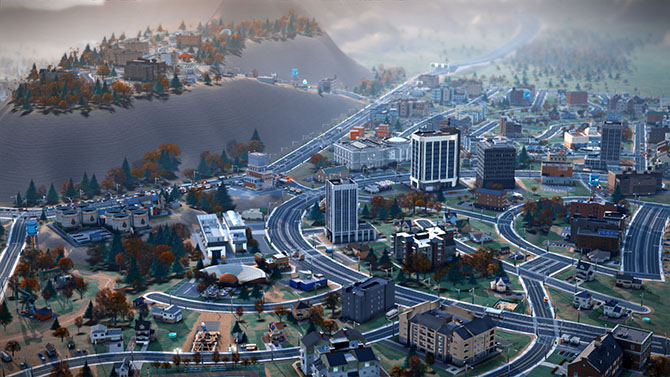
Car oriented development looks a lot more viable when you hide all the parking!
Yes, the first attempt at a comprehensive city planning game, Sim City, is 30 years old. Jessica Roy in the Los Angeles Times has a good piece on how the game helped turn people onto city planning …
Along the way, the games have introduced millions of players to the joys and frustrations of zoning, street grids and infrastructure funding — and influenced a generation of people who plan cities for a living. For many urban and transit planners, architects, government officials and activists, “SimCity” was their first taste of running a city. It was the first time they realized that neighborhoods, towns and cities were things that were planned, and that it was someone’s job to decide where streets, schools, bus stops and stores were supposed to go.
… while also reinforcing some bad 20th century ideologies. Sim City …
- conceals the impacts of parking, thereby making car-dependent development look more functional and attractive than it is.
- requires single-use zoning. You can’t live above your shop, or have a grocery store in your office building.
- requires car access to every building. Pedestrianized urban cores are impossible, no matter the density.
- treats transit very superficially, not allowing the user to specify routes and frequencies, and giving the misleading impression that any kind of transit, anywhere, produces some vague benefit. Thus there is nothing to stop you from common mistakes like building high density in culdesacs, where efficient transit could never get to it.
Recently, I did a quick look at available iPad city planning games. I tried Megapolis, Designer City, Pocket City, and Sim City: BuildIt. They’re all built on the same four fallacies, and their handling of transit ranges from comical to nonexistent. (Sim City BuildIt actually starts with a greenfield freeway interchange, leaving no doubt what kind of city they expect you to build.)
My past articles on SimCity are here, here, here, and here. Sim City gets credit as a pioneer, but it’s run its course. I hope we see more planning games that try to get transportation right, and games that try to do transit in particular. If you’re working on one, let’s talk!
(Photo: BLDGBLOG)
Cleveland: Kicking Off a Transit Plan
(Photo: GCRTA)
I’m just back from a week in Cleveland, where I introduced our new transit planning project to members of the transit agency board and began the process of working with staff to develop network concepts that will help the public think about their choices. Press coverage of my presentation is here, here, and here. The local advocates at Clevelanders for Public Transit are also on the case.
Cleveland is in a challenging situation. The city has been losing population for years and most growth has been in outer suburbs that were designed for total car dependence. Low-wage industrial jobs are appearing in places that are otherwise almost rural, requiring low-income people to commute long distances.
All this is heightening the difficulty of the ridership-coverage tradeoff. The agency faces understandable demands to run long routes to reach remote community colleges and low-wage jobs, but because these services require driving long distances to reach few people, they are always low-ridership services compared to what the agency could achieve if it focused more on Cleveland and its denser inner suburbs. There’s no right or wrong answer about what to do. The community must figure out its own priorities.
To that end, we have helped the agency launch a web survey to help people figure out what the agency should focus on. In April, we’ll release two contrasting maps that illustrate the tradeoff more explicitly, and again ask people what they think. Only then will we think about developing recommendations.
If you live in Cuyahoga County, please engage by taking the survey!
A US Density Revolution?
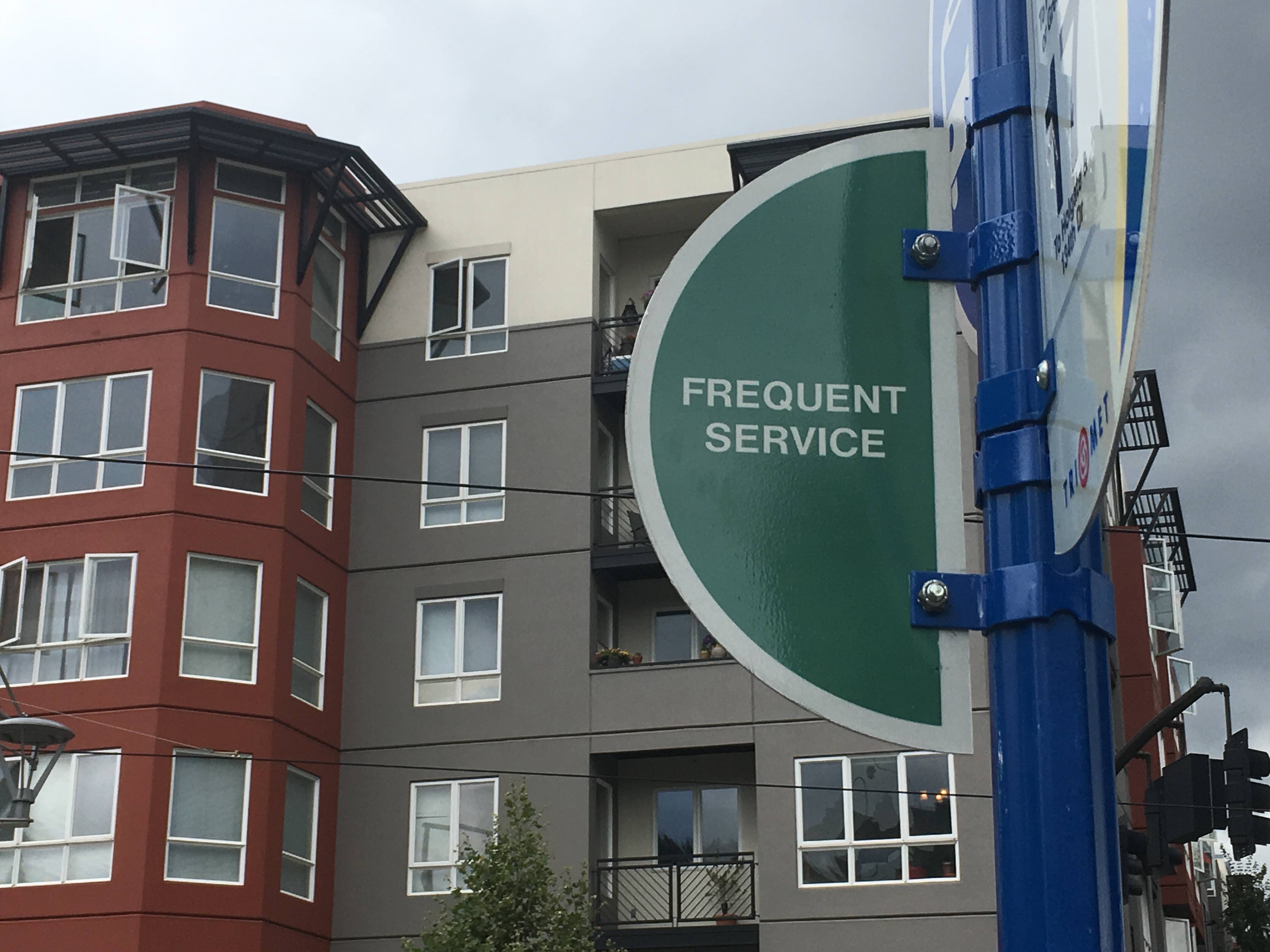
These two things are connected!
In major cities and some states across the US, the tide seems to suddenly be turning in favor of density. James Brasuell at Planetizen has a thorough survey of these efforts. Read the whole thing.
An inescapable trend emerged in recent years and months: a large and growing number of communities are now engaged in comprehensive plans and zoning code revisions, and they’re doing that planning work in the hopes of creating a future that is fundamentally distinct from the 20th century model of planning.
But the revolution Brasuell describes is about much more than planning documents. The story is political: In response to the housing crisis, both city and state politicians are producing legislation that makes it easier to build densely by:
- reducing off-street parking requirements, which makes denser development pencil out and can also make units more affordable
- streamlining transit-oriented development, including around frequent bus corridors and
- most controversially, allowing more density in neighborhoods that have long been legally protected as exclusively for single family homes.
All this is great news, not because everybody wants to live at high density but because more people want it than can currently afford it. The extreme cost of living in dense and walkable cities is the sound of the market screaming at us to build more of them, and finally that’s becoming possible.
From a transit perspective, I have one note of caution when it comes to upzoning absolutely everywhere. Most cities have places that are hard for transit to get to, and where a few more people will create transit demand that is very expensive to serve. Sometimes they are physically hard to reach: long cul-de-sacs, squiggly streets, etc. But sometimes too they are so sparsely populated that they are poor transit markets and adding a few more people isn’t enough to make them better.
Gentle upzoning of single-family areas — allowing second and third units on formerly single-family parcels — is mostly helpful, but not always in these tough spots. In any case, serious density must be organized around the frequent transit network — bus and rail — so that more people end up in places where transit can be really useful to them. Don’t know where yours is? There should be a map of it somewhere, reflecting a policy adopted by both your transit agency and your city government! It should be on the wall in both the transit agency and the city’s planning and traffic offices. (See Chapter 16 of my book, Human Transit, for more on this tool.)
Transit is expensive. It succeeds when it can run in straight lines through dense and walkable places, so that it has enough ridership over a short enough distance that it can afford high frequency. A policy frequent network, agreed upon by the transit agency and the city government(s) and manifested in both zoning and traffic planning, was critical to jumpstarting the growth of transit in Seattle, which is now one of the US’s great success stories. It could make a difference for your city too.
Bus Crashes Auto Show with Killer Ad
By Christopher Yuen
This coming weekend for the first time, GO Transit, Toronto’s regional transit agency, will be displaying one of their buses at the Canadian International Auto Show. They’ve also made a fantastically theatrical ad touting an amazing technology that’s even better than the self-driving car.
Dramatic? Yes, but only fitting for a densely populated city where nearly 50 percent of commutes into downtown are made by transit, and where the mobility of everyone is dependent on not everybody travelling in individual cars, self-driving or not.
Lyft Lobbying to Keep Cities from Governing Themselves
Portland’s mayor and transportation commissioner have blasted Lyft for lobbying the State of Oregon to prevent Portland from regulating to manage the impacts of Uber and Lyft on the city. Their scathing letter to Lyft’s Chief Policy Officer Anthony Foxx (former Charlotte Mayor and USDOT secretary) is worth reading in its entirety. It’s copied in full below.
The principle here is clear: Dense cities have unique problems that arise from the shortage of space per person, which is what density is. When state governments led by suburban and rural areas overrule dense cities, they are demanding that dense cities be governed as though they were country towns. It’s not a cultural problem or an ideological problem. It’s a geometry problem.
Outer suburban and rural areas don’t experience a severe shortage of space on streets, so it’s understandable that they see Uber and Lyft mostly as great companies offering a great product. Only dense cities experience the severe downside: increased vehicle trips due to repositioning movements from one job to the next, and a shift of customers into cars from more sustainable modes like transit, walking and cycling.
Only dense cities understand the problems of dense cities. They have to be able to act to address those problems.
Here’s the full text of the letter from Portland Mayor Ted Wheeler and Transportation Commissioner Chloe Eudaly:
February 4, 2019
The Honorable Anthony Foxx
Chief Policy Officer and Senior Advisor
Lyft
185 Berry St., Suite 5000
San Francisco, CA 94107
Mr. Foxx,
In 2015, the City of Portland, Oregon established an innovative pilot program to evaluate whether Transportation Network Companies (TNC) should be added to Portland’s existing private for-hire transportation system. In taking this approach, we wanted to give Portlanders access to a new transportation option while ensuring that TNCs served all Portlanders safely, fairly and reliably.
As one of the two TNCs to take part in the pilot, Lyft was a model participant. When issues or concerns arose, Lyft worked closely with the City of Portland to resolve them. This collaborative spirit was one of the primary reasons why our City Council decided to make TNCs permanent in January 2016. In the ensuing three years, Lyft was a good corporate citizen, including promptly paying over $52,000 in fines after failing to properly track the number of drivers on your platform, and worked closely with the City to deliver a convenient, safe transportation option.
Until now.
We have been dismayed to learn that Lyft is behind the effort to pass a bill to eliminate local consumer, safety and disability-access protections for people who use Lyft and other TNCs. If your lobbying efforts were to succeed, Portland would no longer be able to manage our transportation system to best support the mobility, safety, accessibility, sustainability, and equity needs of our City.
To be frank, we are puzzled by this. After all, you were a mayor and certainly appreciate the important role that cities have in managing their transportation systems. In addition, when you were appointed to your position at Lyft, you noted that, “Lyft has led the industry with its collaborative approach to working with regulators….” As a company, Lyft has committed to bold sustainability goals and to creating a world designed for people, not cars. Finally, when Lyft co-Founder and President John Zimmer visited Portland last year, he reinforced these values and his interest in working with cities on transportation innovation, whether by car, bike, or scooter.
Your current efforts to avoid local consumer protections and skirt policies that ensure that TNC rides are safe for all passengers and accessible to people with disabilities run completely contrary to your stated positions and the positions of the company you represent.
Specifically, the bill Lyft has proposed and is attempting to pass would eliminate the ability of every Oregon city from taking the following common sense steps to protect TNC passengers:
- Requiring thorough background checks for TNC drivers and mandating that Lyft and other TNCs ban drivers who pose a danger to the public.
- Prohibiting companies from charging passengers with disabilities higher prices during busy times.
- Conducting field safety audits to ensure that vehicles are reliable and do not pose a danger to passengers.
- Requiring that Lyft and other TNCs do not discriminate against passengers based on their race, ethnicity, religion and other factors.
- Conducting spot checks to verify that drivers are who they say they are.
- Adopting regulations to provide better service for people with disabilities and low-income people.
- Issuing permits to make sure that Lyft and other TNCs follow the law.
- Creating programs to investigate when Lyft and other TNCs provide poor service.
- Penalizing companies and drivers when they endanger, discriminate against or otherwise fail to provide safe, fair and reliable service to passengers.
- Adopting regulations aimed at supporting drivers and consumers, including establishing insurance minimums.
- Collecting local data, which is critical for understanding congestion and climate impacts.
- Charging local fees necessary to maintain the consumer protections that have been established.
- Establishing related programs and policies that advance safety and mobility goals.
In Portland, we have successfully protected the health and safety of private-for-hire passengers for over a century. We firmly believe that local governments are best positioned to provide oversight and management of their transportation systems and to ensure that safety, equity and sustainability goals and commitments are met. This has never been truer than with the emergence and rapid growth of the TNC industry. This proposed legislation is contrary to this bedrock philosophy that the best oversight of the transportation system and the private-for-hire industry is local. Not only that, but it is a disservice to passengers, drivers and the general public who expect safe and reliable service and who are expecting you to stand by your sustainability and community commitments.
We look forward to a modification in Lyft’s position on this Oregon legislation.
Sincerely,
Ted Wheeler, Mayor
Chloe Eudaly, Commissioner of Transportation
“New Mobility”: Drowning in a Sea of Meaningless Words
I’m in the World Bank’s generally excellent Transforming Transportation conference in Washington DC. The theme is “New Mobility.” In the first panel, I found myself agreeing with almost everything the panel said, to the extent that I could understand it.
The limit to my understanding was the use of meaningless words: new mobility, micromobility, sharing.
These words each have too many meanings, which is the same as having none. That is a good sign that they have arisen from the language of sales. Selling a product requires exaggerating its relevance. If a word makes people feel good, the marketer will try to figure out how to extend the word to cover her product.
All three of these words feel good: New mobility sounds cutting-edge. Micromobility sounds intimate, maybe even cute the way little things are. Sharing — well, we all think toddlers should learn to share.
But on this morning’s panel I heard all three words used with apparently conflicting meanings.
- Sharing was used sometime to mean “sharing of rides” (different people with different purposes riding in same vehicle at the same time, as in public transit), but also to mean “sharing the vehicle” as in bikeshare and carshare. (There’s also sharing of infrastructure: Motorists are expected to “share the road.”) These are different concepts with different uses and consequences. When the moderator polled us all on what words we associate “new mobility,” the top answer, of course, was “shared.” The more meanings a word has, the more popular it will be, which in turn means it will give more people that warm buzz that comes from being surrounded by people who (seem to) agree with them. That’s the mechanism by which words grow both popular and meaningless.
- Micromobility is often used to mean “person sized vehicles” — bikes, scooters, and other things that let someone move faster than they can walk without taking much more space than their body does. But when the Mayor of Quito was asked about it, his answer seemed to include microtransit, which is an utterly different thing. I suggest “person sized vehicles,” (PSV) It’s five syllables instead of six, and it actually says what it means.
- New mobility says nothing but that it’s mobility and its new. New things have absolutely nothing else in common, so why is this a meaningful category? Only if you want to appeal to the common prejudice that all new ideas are better than all old ideas, which we all know to be nonsense. After all, most innovations fail.
I’ll talk about this on a panel this afternoon. If we are going to think clearly, we have to use words that mean, not words that sell.
Meanwhile, if you hear one of these words, or any other word that seems to used in multiple ways, ask for a definition. You have a right to that. Only then are you actually thinking together.
New York: Mayor Vows to Increase Bus Speeds
In all my years of working on transit in North America, I’ve heard lots of mayors make announcements about rail projects and various new technologies. I’ve heard many make vague supportive statements about bus service. I’ve even heard them advocate for more bus service. But I’ve never a big city mayor promise to dramatically speed up buses all over a city. (Correct me if you have.)
Vin Barone at AMNY reports that New York Mayor Bill de Blasio will announce a commitment to increasing bus speeds across his city by 25%.
This is a very high number! Admittedly, it’s a low base, with so many New York city bus routes running so slowly that it’s sometimes faster to walk. Most individual interventions I’ve encountered improve speed by much less than 10%. So hitting 25% will require a huge range of actions.
These actions can be sorted into two baskets: Cost and Controversy.
Some problems can be solved with money, without too much controversy. All of the following are planned, either by the City or by the transit agency (MTA).
- Improving signal priority systems, which is a matter of signal technology. (City)
- Improving enforcement of bus lanes. (City)
- Improving active supervision to reduce bunching, via a “Bus Command Center” (MTA)
- All-door boarding via fare-card readers at rear doors, and roving fare enforcement (MTA)
All that is mostly money, both capital and operating. Lots of it. And all together, it is unlikely to get you to 25% citywide.
The other big step involves controversy rather than money. More bus lanes need to be created, and the space for them will come from some other street use, usually parking lanes, traffic lanes, and versatile curb space for pickups and deliveries. Bus facilities cost money too, but winning these battles is the bigger struggle, so the cost is really in political capital rather than money. All of these impacts are profoundly controversial in a dense city, which is why cities tend to do them only after they’ve exhausted all the other options, and why so many bus lane plans are watered down, and made less functional, through the public outreach process.
The mayor’s target will work if it becomes a consistent direction to city government, fully explained to the people, so that not achieving it is not an option. When we work on this process, we do a lot of work in explaining why the target is what it is, and building some consensus around it, so that staff will have political support to not compromise as the inevitable objections roll in. The mayoral declaration is a huge step. It remains to be seen if the target holds in the face of the controversy.
Because ultimately, while money is an obstacle, controversy is a much, much bigger one, and is the main reason big-city bus service usually doesn’t improve.